Élevé · Issue 4 · Quietly Extraordinary
Finding Her Way Back to the Game
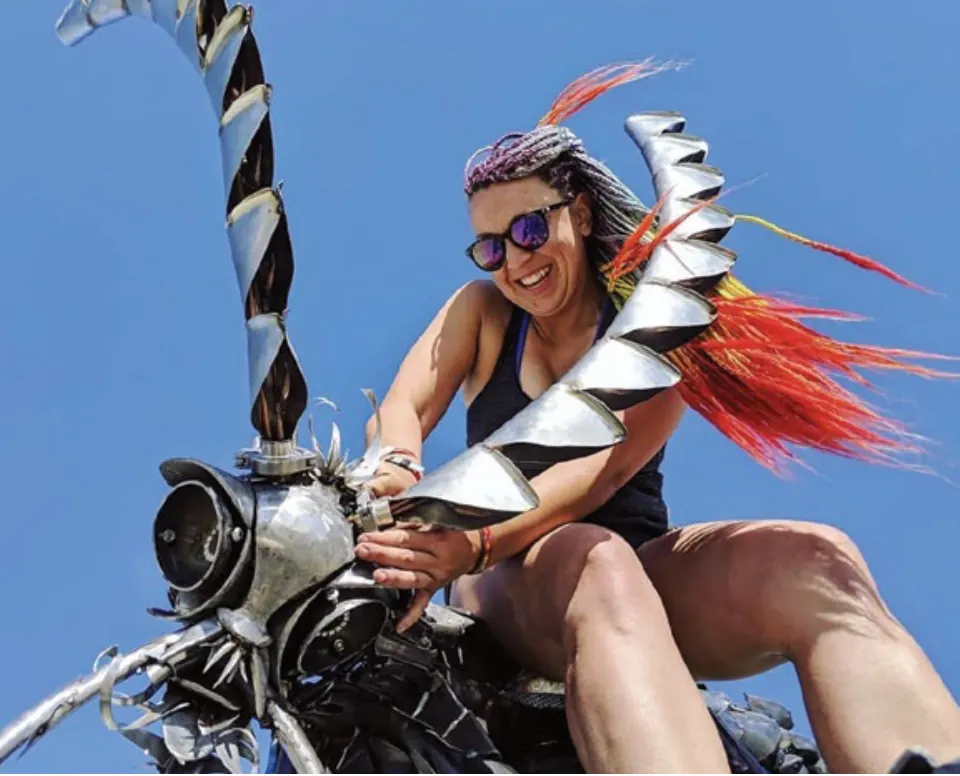
Milli Bruce says yes to almost everything, but it took her friend years of asking before she agreed to join Flaming Lotus Girls, a women-led collective that builds towering, fire-breathing kinetic sculptures for Burning Man. Every year, the invitation came. Every year, she had a reason to decline. Wednesdays weren't good for her. She was busy. There was always something.
What finally got her in the door wasn't the art itself. It was a promise: they would teach her to weld.
"I always thought that would be a really cool skill to be able to say that I could do," Milli says. That, combined with the fact that she was already headed to Burning Man that particular year, tipped the answer from no to yes.
She remembers the first time she picked up a torch with unusual clarity. It was loud. Louder than she expected, and a little frightening in a way that also felt powerful. She learned to tack weld first, laying down a tiny bead just to hold two pieces of metal together, before moving on to the real seam. Welders compare that motion to handwriting, a flow you have to find in your hand and trust.
Her first attempt was rough. Her second wasn't.
"I remember doing it, and the first one was really bad," she says. "And then the second one, I was like, that is so pretty, and I did that."
It didn't take her long to get the hang of it. She'd later learn something that stuck with her: women, she was told, tend to make especially good welders because of finer motor control. Whether or not that's the reason, Milli found something in the torch that felt less like a tool and more like a rhythm. "It felt almost like dancing," she says.
Within a relatively short time, she went from someone who didn't know how to weld to someone teaching others. She loved it. Passing the skill along meant someone else got to feel, for the first time, what she'd felt the moment her second bead came out clean.
But learning to weld inside Flaming Lotus Girls meant something beyond the craft itself. The collective is explicitly women-driven, though men are welcome, so long as they abide by an unwritten rule: never take a tool out of
Outside that shop, in the other male-dominated spaces she's moved through over the years, whether in sport or at work, that instinct to second-guess her own place has been harder to shake.
"It really challenges your confidence," she says. "And like, having to go: no, I do belong. I am allowed here, and I do get to take up space in this space."
That belief, hard-won inside a welding shop, is the thread that runs under everything else in Milli's story.
The piece she's proudest of is a sculpture called Brazen, one of three giant fireflies her collective built together, alongside two others named Metric and John. (John is, by universal agreement within the group, a girl. Her name is still John.) Milli started with Brazen's wings and, once she'd built real ownership over that part of the piece, pushed to take the face through to completion too.
There was no manual for any of it. She looked up pictures of real fireflies, took stock of whatever raw material the group had on hand, and figured out, piece by piece, how to make something that didn't exist yet look like it belonged in the world.
The scale of the commitment is easy to undersell. The idea for a new sculpture typically starts forming as early as November, with the real someone's hands. It exists, Milli says, because men would sometimes step in uninvited to show a woman "the right way" to do something she already knew how to do. work ramping up by March or April, building toward a hard deadline: the last week of August, when Burning Man begins. In the final stretch, Milli was spending twenty to twenty-five hours a week in the shop, after a full day of work, often twelve-hour days on weekends. At the time, she was self-employed as a personal trainer, working with clients in the mornings and evenings and disappearing into welding in between. She and her collective mates once did the math on what all those volunteer hours were worth against the free festival ticket they received in exchange. They decided not to finish that calculation.
As the project matured, so did her role. Milli became the installation project lead, arriving on the playa a week early to help set the very first stake in the ground, then managing as many as fifty volunteers as the week went on, constantly fielding one question: Milli, what can I do? It meant reading people's skill levels and attention spans in real time, finding ways to keep them engaged so they'd come back the next day. "Very exhausting," she says, "and also very rewarding."
The first time she saw Brazen fully assembled and lit up on the playa, fire moving along its body, she was, in her own words, lost for words. Pride, but also something closer to wonder: the strange thrill of stepping back from months of close, intricate work and seeing the whole shape land. Her mother came to that Burning Man and saw the piece Milli had built, which added, she says, an extra layer she hadn't expected.
The skills didn't stay in the shop. Milli has since used what she learned to fix things at home, including replumbing the gas line on a new dryer herself, complete with a trip to the hardware store where she confidently rattled off the names of every fitting she needed. She did the whole job with a long set of acrylic nails still on.
"I felt extra badass doing it," she says. "And it worked. I was so proud."
That contrast, girly and capable, delicate and industrial, is one she's come to enjoy rather than resolve.
By 2022, though, the same intensity that made the work meaningful had also worn her down. That year's project asked more of a smaller group of people carrying the load, and Milli, working full time by then with far less flexibility than before, felt the burnout catch up with her. She hasn't welded since, though she's careful to call it a break rather than an ending. The door, she says, is always open. Members of the collective are currently touring past pieces, and she could show up and help anytime.
What's kept her from it isn't disinterest. It's the same challenge most people carrying full lives understand: making the time and actually
“Beyond any title on her business card, what inspires me most about Milli is the quiet, undeniable strength she brings to our conversations at industry events. She walks into accounting spaces fully owning her worth, showing a rare blend of bold self-belief and genuine humility that I deeply admire. Knowing her has shown me that true leadership in any capacity is about knowing you belong at the table and showing up ready to execute. She has made an incredible impression on me simply by being a fiercely capable, grounded force whose character speaks entirely for itself.” - Lynnette Oss Connell,
Burnout Bestie at Reinspired Leadership Consulting LLC
protecting it. "I need to make it a priority," she says, "and make it happen."
If she picked the torch back up tomorrow, she has two ideas already waiting. One is another organic creature made unexpectedly out of metal, something soft-looking built from something hard. The other is smaller and more personal: a metal frame for a dining table, topped with a beautiful slab of wood, an art piece she made herself, living permanently in her own home.
Milli doesn't call herself an artist. Friends and colleagues, watching the color she brings into her house and her life, tend to disagree. But she's not especially interested in winning that argument. What she wants, more than the label, is for other people to go find their own version of what welding gave her.
"Not to do it to be good at it," she says, "but to do it because it's good for our souls."
Text adapted from the print edition of Élevé.
 Twenty Years Later, She Still Knows Every Note
 Wonderful Chaos
 On Point