Élevé · Issue 4 · Quietly Extraordinary
Wonderful Chaos
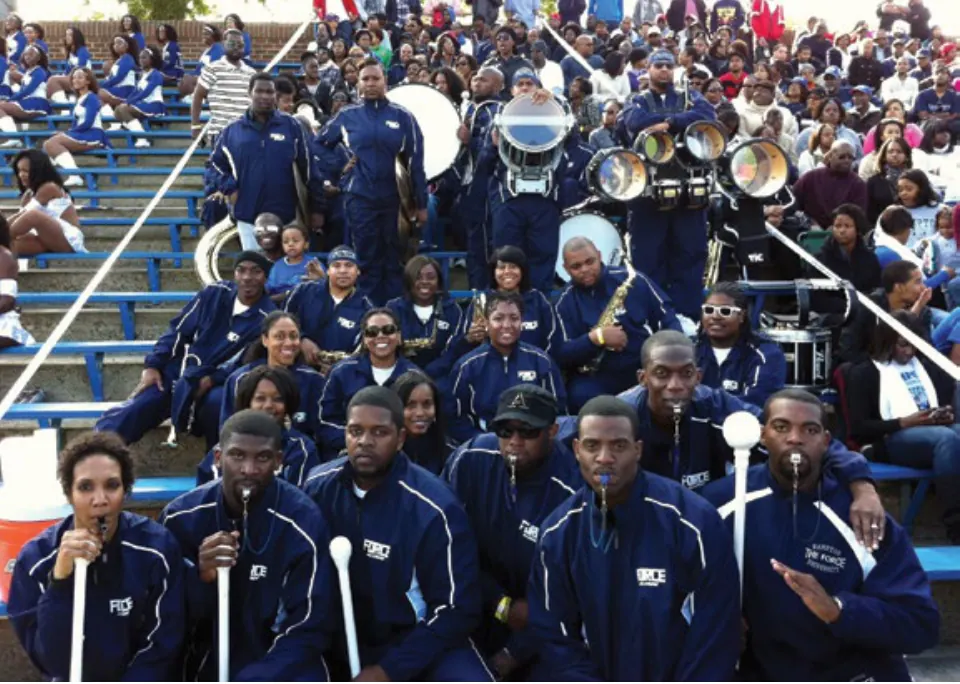
Lauryn King Darden picked the flute in fourth grade because it was the lightest instrument to carry home. Nearly two decades later, she still remembers every song she ever learned to play, the muscle memory left over from four years marching piccolo in Hampton University's band, a chapter so consuming it dictated her sleep, her meals, and her weekends for the better part of college. “It's almost twenty years later, and I still remember how to play certain songs,” Lauryn says. But what she took from that experience was bigger than music. It was a discipline, a sense of pride, and a feeling of total acceptance that she says she wouldn't fully understand the value of until she left it behind.
Music runs in her family. Her mother played French horn. Her father played trumpet at Morgan State, another HBCU, and growing up, Lauryn watched A Different World, the sitcom about a fictional Black college that made attending an HBCU feel less like an option and more like an inevitability. What sealed it was Drumline. “I was like, I have to figure out how to go there,” she says of watching the film's depiction of HBCU band culture.
Her parents had other ideas about where “there” should be. Clark Atlanta University, near Morehouse and Spelman College, was ruled out for distance. Howard University, in the middle of Washington, D.C., was ruled out after a friend's brother had his car carjacked in the city. Hampton, six hours from her home in New Jersey and set on the Virginia coast, split the difference: far enough to feel like her own life, close enough for her parents to reach in a single drive. The school even had a sailing team. Students and Alumni call it “our home by the sea.”
The choice solidified the summer before her senior year of high school, when Lauryn attended a band camp on Hampton's campus and marched alongside students who would later become her actual classmates. “That's what kind of solidified it,” she says. “This is a cool experience. I really enjoyed it.” She arrived that fall already knowing a few faces, including her middle school best friend, who had been accepted to Hampton independently, without either of them planning it. They became roommates for the next several years. She was the matron of honor at Lauryn's wedding; Lauryn stood beside her at hers.
Discipline as a way of life
Freshman year in the band came with a list of rules that Lauryn still recites easily. Be fifteen minutes early to everything or run laps as punishment.
During band camp, rehearsals ran from roughly 8 AM until 9 -10 PM. Then once school started, it filled every weeknight from about 5 PM – 10 PM, and Saturdays were for football games and halftime shows. “I was in the best shape of my life,” she says. She sometimes skipped dinner entirely, eating a cup-o-noodles alone in her room just to get a moment of solitude in a schedule that otherwise left none.
The standard for precision was unforgiving. Sectional rehearsals existed to catch anyone who wasn't playing exactly right, because in a band, one player out of step can undo the whole formation. “If everybody's wrong, one percent of the time, it's going to sound like a train wreck,” Lauryn says. “You have to be very accurate and very together.” Nobody wanted to be the reason it fell apart. By her junior year, she had become assistant section leader; by senior year, section leader, a role that required her to be excellent on her instrument and capable of leading a group of people who relied on
No shortcuts, meaning no walking in the grass and no taking elevators, only stairs. If an upperclassman spotted a freshman walking at practice, that freshman had to run laps. In each instrument section, hers being the piccolo section, all freshman players were required to stay together at all times, a rule she now understands as part bonding exercise, part protection in an unfamiliar place. her to be both.
There were smaller rituals, too, ones that stuck. The band traveled by bus, five or six at a time, to games across the country. The road trip meals were reliably buffet stops at Shoney's or Golden Corral. “To this day I will not eat at a Golden Corral,” she says. “I almost gag when I see one.”
What it took to see it clearly
Lauryn describes the years immediately after graduation as a kind of quarter-life crisis, the sudden absence of structure leaving her unmoored in a way she hadn't anticipated. But the fuller reckoning came once she was working in public accounting, often as the only Black person on her team. “I definitely experienced microaggressions being in corporate America for almost fifteen years,” she says. It wasn't always something she could name in the moment.
Things happened that “didn't make sense” to her, she says, before she came to understand them as microaggressions or unconscious bias. She noticed, too, that the way she naturally communicated, expressive and emotionally direct, read differently in a corporate setting than it ever had at Hampton. “That's not always accepted in corporate America,” she says, describing a manager who seemed intimidated by traits she'd never had to hide before. “I had to figure out how not to be myself.” It took years, she says, before she learned to bring her full personality back into her work.
What Hampton had given her, she's come to believe, was something particular to a Black student at a Black institution: a place to build confidence and identity without first having to explain or justify herself. “It's just something about being at that HBCU that helps you grow up and helps to nurture you in a way that I don't think I've experienced anywhere else,” she says. It was going back to Hampton for homecoming, after she'd had that corporate experience, that the acceptance she'd known as a student came into full focus. “Going back to homecoming after working was when I really felt that acceptance and love,” she says.
That recognition extended to how she thinks about HBCUs more broadly, and to a standard drilled into students well before graduation. Ahead of job fairs, students were expected to show up in full suits and pantyhose, hair done a certain way, polished well beyond business casual. “I went to interview at different companies for internships, and my colleagues from Hampton and I were normally the best dressed,” she says. “I went to fight a ticket in court once, and they thought I was the lawyer.” She's since come to understand why the standard existed, not because it reflected what most jobs actually required, but as armor against a bias she says Black professionals are often held to before they've even had the chance to prove themselves. “We shouldn't have to do all that to be accepted,” she says, “but you can't act like everybody is all healed and forgiven and is going to see you equally. There's still bias. It still happens.” It's a tension she's made peace with rather than resolved, and one she says Hampton equipped her to carry in a way she isn't sure any other school could have.
Twenty years on, Lauryn still returns for homecoming most years, piccolo in hand, rejoining alumni who remember the same dances and the same calls the current students are still learning. Her closest friendships from that era, including the one that started in middle school, have outlasted every year since. Looking back, she describes that whole chapter in a single word: freedom. No job yet, no children yet, just the discovery of who she was going to be.
What she wants people to take from her story isn't nostalgia. It's a case for keeping music
“Lauryn is an incredibly caring person who truly takes the time to get to know you first so she can serve you better. She also has the uncanny ability to see the holes in a process, combined with the knowledge to identify risks and put effective measures in place to fix them.” - Michelle Mitchell,
CEO & Founder of Mitchell Consulting
programs alive in schools, the kind of programs that are often the first thing cut when budgets tighten. To her, band taught something no other class did: how to be excellent individually while never trying to outshine the people around you. “It's not okay to suck,” she says. “You don't get a trophy because you just participated. You have to contribute and work well together.” It's a lesson she still lives by, decades after she last marched onto a field, and one she hopes stays available to the next kid who picks up an instrument because it happened to be the lightest one to carry home.
Text adapted from the print edition of Élevé.
 On Point
 Clearing the Runway
 Better Than She Could Have Imagined