Élevé · Issue 4 · Quietly Extraordinary
Thirty-Three Years, and Grateful for Every One
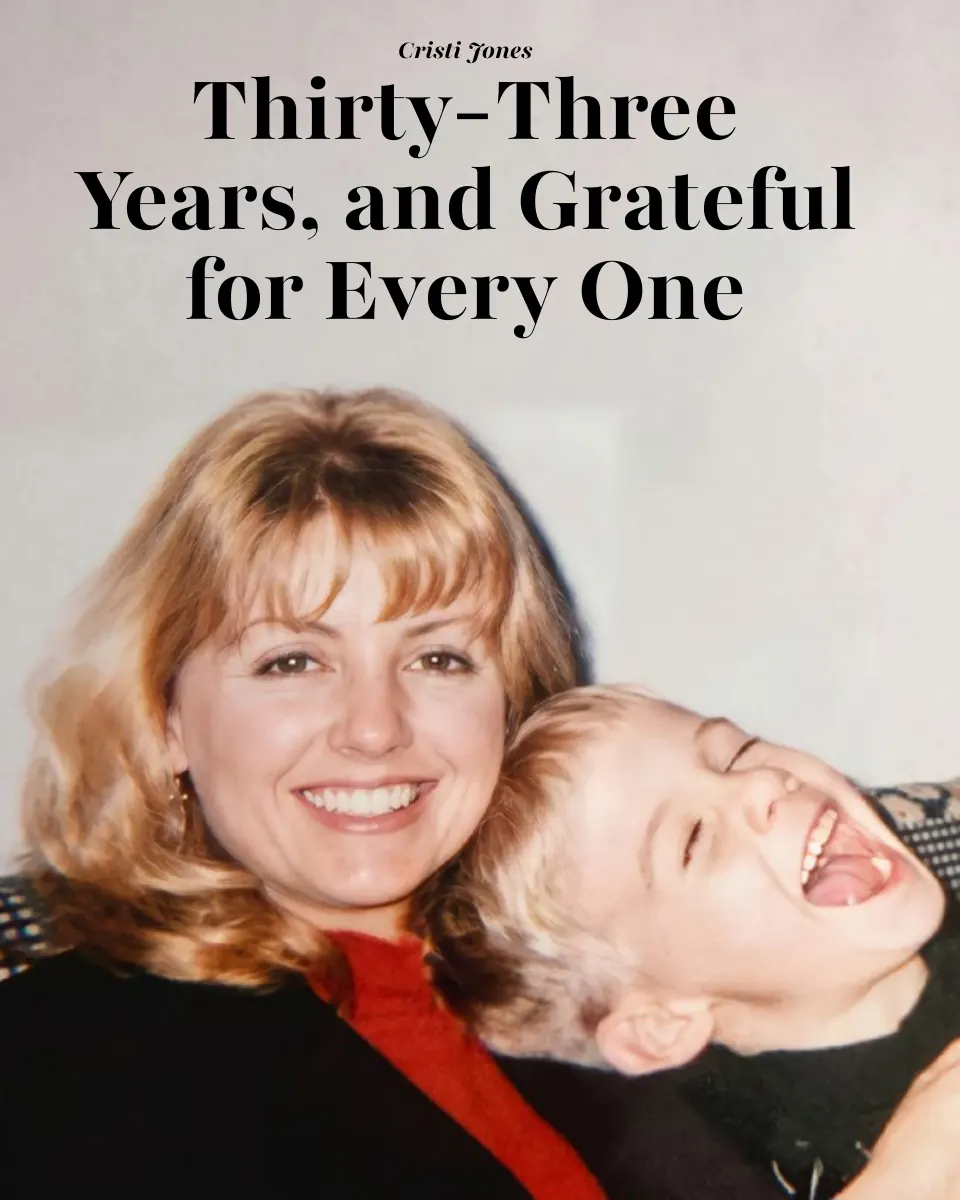
To meet Cristi Jones now, you would not guess how much she has weathered. Twice, grief arrived at her door, and twice she answered it as a different person. The first time she was nineteen, standing in a church parking lot in Florida when another mother's scream told her what the search parties had not yet confirmed. The second time she was thirty-three, watching her mother and business partner slip away one function at a time. "I was a pretty miserable human being for a couple of years," she says of that first loss. What she learned in the distance between the two is the quieter, harder thing: that grief can be met on purpose, and that the meeting changes everything.
It began before eleven in the morning, at a restaurant near her college where she was working. Her childhood best friend walked through the door. It was strange to see her there before opening. "We have to go," the friend said. Her brother was missing in Florida. He had been on a school field trip.
He was fourteen. He was her only sibling.
He'd had a hard time at home, and he had found himself at a boarding school about an hour and a half away, the Darlington School, where, for the first time in a long time, he was happy. He made friends with everybody, especially the international students who, like him, lived on campus.
"He was so happy there," Cristi remembers. "He was really, really funny."
Then the field trip. A storm that had been forecast. Children in canoes and kayaks on the water in February with no adequate communication equipment. They were all scared before they even reached their destination. By the time the group reached the islands where they were meant to camp, the islands were underwater from storms in seasons past. Ten kids and two adults set out; eight children and both adults were pulled from the water by helicopter. Her brother and his best friend were not.
She rode down to Florida with her grandparents. What she remembers next is the map.
They were at the police station, studying a search grid while boats and helicopters worked the water where the Suwannee River empties into the Gulf. Cristi has always been a fixer. She wanted a task, a way to help find him. Then an officer came over, took the map from their hands, and told them to head back to the church, where the other families were waiting, the ones whose children had already been found.
As they got out of the car in the parking lot, she heard screaming, and for one bright second she thought it meant they had found him.
Then she heard the other boy's mother. "Not my baby," at the top of her lungs.
They learned it there, in the parking lot, before anyone walked inside.
The funeral drew more than a thousand people, with news trucks parked outside. Before the service, Cristi went in to see her brother and thought there was too much makeup on him, that he didn't look like himself. She turned and ran out of the church, insisting it wasn't him, and had to be steered back inside, away from the cameras. For two or three months afterward she had the same dream: that she arrived at the funeral and it wasn't him, and then woke back into the fact that it was.
"I don't remember a whole lot of the next two years of my life."
She was angry, at God, at the world, at the unfairness of it landing on someone so young. Someone would mention a headache and she would think, but you have a brother. She had no empathy to spare. She hated being the girl people wanted to hug, the pity case, and she kept everyone at arm's length. She had turned away from the faith her mother built the family on, and she ran from the grief instead of facing it.
"My life kind of blew up around me, unrelated to it, just because of my attitude."
Fourteen years later, in 2016, her mother was diagnosed with ALS.
They had been inseparable. They owned a two-person tax firm together and worked side by side every day, roughly a thousand clients between them. During tax season they wouldn't cook. They'd have their husbands bring the kids and meet them for dinner, because who had anything left after a day like that.
Cristi knew almost nothing about ALS, only the ice bucket videos everyone had shared. Her mother, rational and steady, not one to overreact, led even this. Her first words after the diagnosis were about her daughter. "This isn't hereditary. It's not something you're going to get."
She went looking for every option. She flew to Thailand for two weeks of stem cell injections that were not yet legal in the United States. She felt better for a couple of weeks. It didn't hold.
Over the next two years, Cristi watched her mother lose one function at a time.
Her mother could still speak for the first six or eight months, long enough to record voice notes to tuck inside stuffed animals for her grandchildren. She set the tone for how the family would carry it. No sitting around lamenting. Parties, visitors, quality time. "We're going to do what we're going to do."
When the firm landed entirely on Cristi's shoulders, her mother told her to close it. "Just close it. I'll take care of you."
Cristi said no. "You worked thirty years for this company. I can keep it going to sell."
Her mother's answer was the same reassurance she offered everything. "Okay. You can. But if you don't, it's okay."
So Cristi turned her grief into determination, and this time she did the thing she had not done at nineteen. She faced it. Therapy and self-reflection were a large part of that. It charted the course to a healing journey, being able to care for her family that was also grieving such a great loss, and eventually landing in one of the most satisfying and enjoyable professional roles she has ever had.
"The first time, I didn't acknowledge it. The second time, we were going to cherish this experience even though it's bad, and use it for good somehow."
There is a detail that holds the whole difference. In the years after her mother's death, clients would still come into the office and break down crying about her, the woman who had been Cristi's partner and best friend. Imagine doing someone's taxes while they weep about your late mother. Cristi chose to hear it as evidence of how loved she had been.
"Having her for thirty-three years beats having someone else's mom for a hundred."
Both losses left her holding the same sentence, the one everyone reaches for: life is too short. But she is careful about what she means by it.
Life's too short is not a license to quit without notice, or torch a friendship, or blow up a marriage on the way out.
“Cristi Jone’s fingerprints are on parts of Anchor that most people would never know about. She has a rare ability to spot where an experience could be better and think through how that improvement should work not just for Two Roads, but for firms she will never meet. She consistently partners with us to create solutions that give service providers more flexibility and more value, while keeping her own clients in steady hands the entire time. Heart, ownership, grit, exponential value - the four values we hold ourselves to at Anchor. I have watched Cristi live every one of them from the other side of the table.” - Rebecca Shain, Team Lead Customer Success, Anchor
She is friends with her ex-husband. They co-parent so easily that their daughter sees them joking together, and she guards that on purpose.
"You can have boundaries and empathy at the same time. Those things can live together."
The point, for her, was never permission to leave. It was how you leave. "If you can walk away feeling like you gave it a hundred percent, and you exit with kindness, that is the most important thing in the world." She watched her mother navigate change that way and took the lesson down to the studs.
If her mother could see her now, Cristi has an idea of what she'd say, because she asks herself the question most days. Not simply that she's proud. That she should keep leading with kindness, and keep raising her kids in it. "Always choose that fight. That's a battle worth choosing every single time."
For anyone reading this in the middle of their own loss, she offers the thing she wishes she'd known at nineteen.
"The sun is going to rise and the sun is going to set. How you care for your own heart, and the hearts of the people around you, in between those times, determines how long this is a challenge for you."
Grieve, she says, but grieve from a place of gratitude. Accept the flowers and the clumsy words with grace, because it means someone was carrying you. Take the day off if you need it. "You don't get a cookie for delaying grief." And don't run the way she once did, because running doesn't work. "If you ignore it, it will be waiting for you 365 sunrises from now."
Then there is the part she saves for last, almost as an aside, the one that sounds like the universe handing something back.
She has a son who looks just like her brother. She named him after her brother. He acts just like him too, funny in the same way, a carbon copy walking around her house.
"God is really funny," she says.
Text adapted from the print edition of Élevé.
 The Woman Underneath
 Running Back to Twenty-One
 Dogs for Good