Élevé · Issue 4 · Quietly Extraordinary
Dogs for Good
Most people never guess she runs it. But Dogs for Good has grown from a quiet side hustle into the place her passion truly lives.
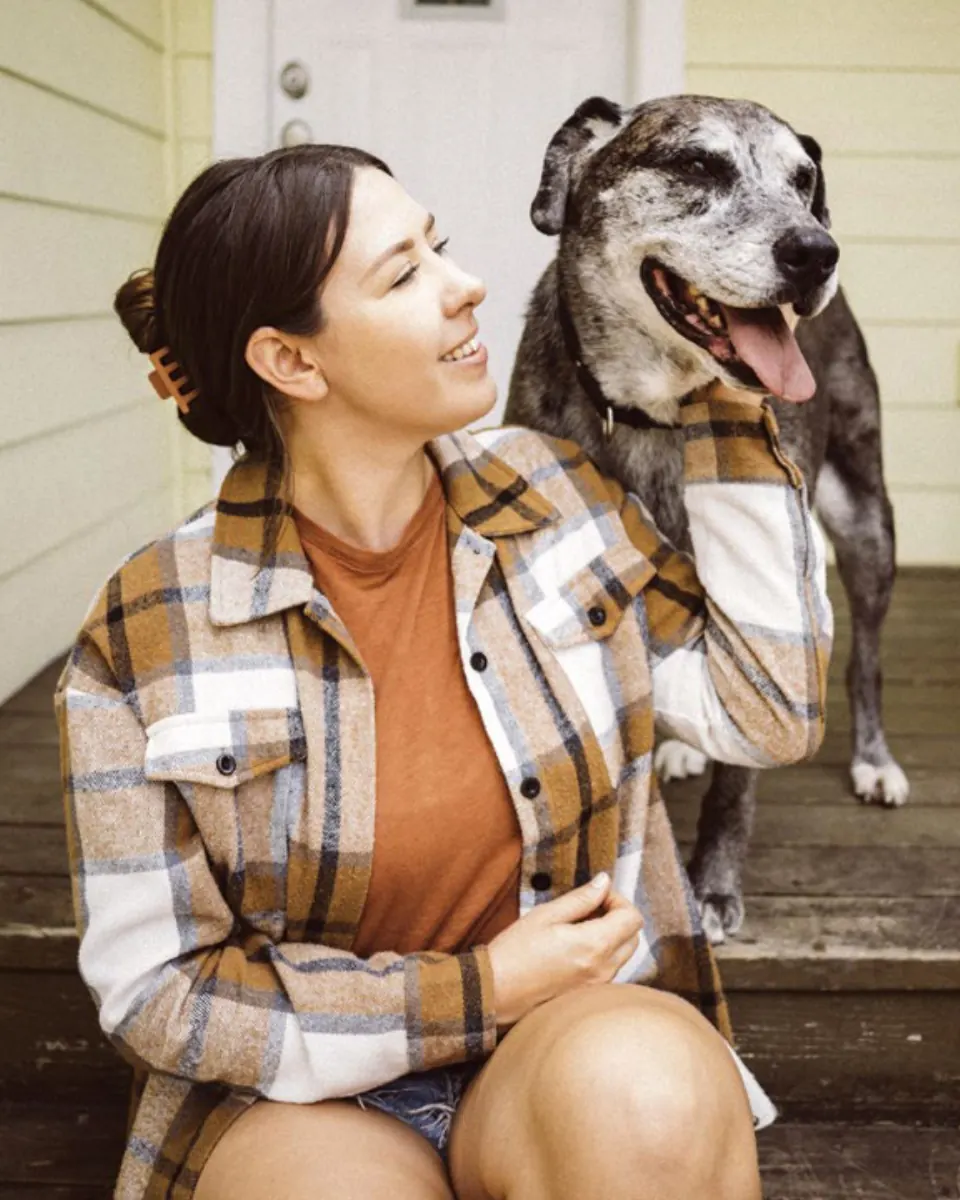
There is a sentence Lauren Marshall keeps returning to, half in disbelief. “I don’t understand how people pay me to do this,” she says. “I would just hang out with your dogs for free.” Four years ago, newly settled in Oregon and suddenly home all day, she signed up on a pet-sitting app almost on a whim. What began as a few repeat clients has become Dogs for Good, a business she built entirely herself, one boarded dog at a time. She gives away ten percent of everything she earns to animal rescues. It is, she admits, more than she ever thought it would be, this quiet thing that grew and grew until it became unmistakably her own.
The app was supposed to be a small thing. A side hustle for a house that had gone quiet when her job went remote and she moved states in the same stretch of life.
Then people started reaching out. A few of them came back. Then a few more.
“It was just great, right out of the gate,” she says.
She had spent her whole working life until then as someone else’s employee. This was different. This was hers.
“I’m actually doing this for myself, earning money for myself, running my own little thing here,” she says. “It was kind of empowering to be building something for myself.”
The love of animals is older than the business by decades. Lauren was the kid outside turning over rocks for roly polies, worms, and snails, anything that moved. There was a small farm in the town where she grew up, and once a week her parents would take her to feed carrots to a camel named Lucy. Her brother worked alongside a wildlife rehabilitator, so birds of prey moved through the family’s orbit. For a while, so did a possum who couldn’t be released back into the wild and simply became theirs.
Dogs, though, are the ones who found the center of her.
“They’re so sweet and loving and caring, and you have that connection to them,” she says.
For years she ran everything through the app and didn’t think of it as a business so much as a habit she got paid for. That changed last year, when she decided she wanted it to do some good beyond her own front door. She began donating ten percent of every dollar to animal rescue organizations. The name came from the same impulse.
“I’m hanging out with dogs, trying to do something good with it,” she says. “That’s pretty much it.”
The organizations she chooses are never random. She follows dozens, and picks the ones that land somewhere personal. One is New York Bully Crew, which rescues pit bulls, a breed she says is badly misunderstood. Another is Project Street Vet, which runs veterinary clinics and hands out food so people without housing can care for their animals too.
The pull toward bully breeds is not abstract. Lauren’s first dog was a pit bull, and he had a long life with her before he passed nearly a decade ago.
Getting another has not been simple. For years she and her fiancé were renting, and a bully breed makes a rental almost impossible to find.
“There’s still so much discrimination around that breed,” she says.
They bought a house a couple of years ago, and now share it with two dogs, but the timing for a third hasn’t been right yet. Someday, she’s certain, there will be another pit bull.
“They’re just giant babies and love bugs if you raise them right,” she says. “A dog is a dog at the end of the day. It’s all about how you treat them, how you raise them, how you train them.”
Ask her about a dog she still thinks about, and one arrives immediately.
He was a blind Italian greyhound, brought over for daycare while his owner, a nurse, worked
THE SURPRISE ROUND
The side business most coworkers don’t know about?
Dogs for Good, a pet-care business she runs herself.
Her honest take on getting paid for it?
What she did before accounting?
Years in education.
Where 10% of every dollar goes?
Animal rescues, including New York Bully Crew and Project Street Vet.
The unpaid employee?
Her 6’4” fiance, a magnet for the smallest dogs.
First dog, and future dog?
A pit bull. Someday, another.
One rule she’ll never break?
“I don’t want someone to ever think that their dog is just one of many.” twelve-hour shifts. Lauren had never cared for a dog with special needs, and she went in braced for trouble. Would he bump into the walls? Manage the stairs? Spend the day frightened?
He did none of it.
“He immediately came in and mapped out the house and figured everything out and had no fear,” she says. He would bump gently into one of her own dogs and be instantly ready to play. When her fiancé came home from work, the little greyhound would sniff him out and find him every time.
He passed away about a month ago, an old man by then, having lived a nice long life. She still speaks about him like someone she was lucky to know.
Her fiancé is what she jokingly calls the unpaid employee of Dogs for Good. He feeds, he helps with the unglamorous parts, and he has become, without meaning to, the favorite of nearly every dog who passes through. He stands 6’4”, and the smallest dogs are always the ones who climb straight into his lap.
“I took care of you all day,” she says she tells them. “Where are my cuddles?”
The day-to-day is deliberately small for now. She boards just one dog at a time, since she has two of her own and a house with limits, and fills the rest of the week with drop-ins, quick loops around a small town where nothing is more than five minutes away.
The dream is bigger than the house can hold. She pictures a property with a barn, kennels built out and insulated against Oregon’s long wet winters and its increasingly hot summers, room to take on more dogs and, eventually, help. What she will not give up, no matter how large it grows, is the feeling that brings people to her in
“Lauren has always shown up with integrity and loyalty to both me and the business. She has taken accountability for her role but also always thought of new ways to reinvent it. She has been a shining light in our customer experience and helped keep me organized and efficient in times of extreme chaos and overwhelm. She is everything people want when they hire an executive assistant or office manager, but few actually get.” - Sam Hallburn, Director of Operations, Devine Consulting, LLC the first place.
“I don’t want to toss a dog in a kennel ever,” she says. “I don’t want someone to ever think that their dog is just one of many.”
Lately, the two halves of her life have started to meet in the middle. At her firm, Devine Consulting, an initiative called Friends of the Flock has begun spotlighting rescue organizations and adoptable animals, an idea born from something the whole team shares. Her first love, quietly, becoming part of the work.
She spent years in education before she ever came to this. She notices the throughline.
“It went from taking care of people’s kids to now taking care of people’s dogs,” she says.
If the business tells people anything about her, she hopes it’s the simplest thing.
“Anybody that dedicates part of their life to any type of care, that shows the type of person they are,” she says. “It warms my heart.”
W O M E N - O W N E D. W O M E N - L E D.
MoneyPenny creates professional career pathways for women in India through training, flexible work, on-site childcare and opportunities to lead.
Meet the women behind MoneyPenny.
Their tax and accounting expertise helps accounting firms around the world build capacity.
Text adapted from the print edition of Élevé.
 The Quiet on the Other Side of Control
 Middle of Nowhere, Center of Everything
 Solo to São Paulo