Élevé · Issue 4 · Quietly Extraordinary
The Quiet on the Other Side of Control
She looked like a woman in complete control. The story is about what it cost her, and what she found when she finally let go.
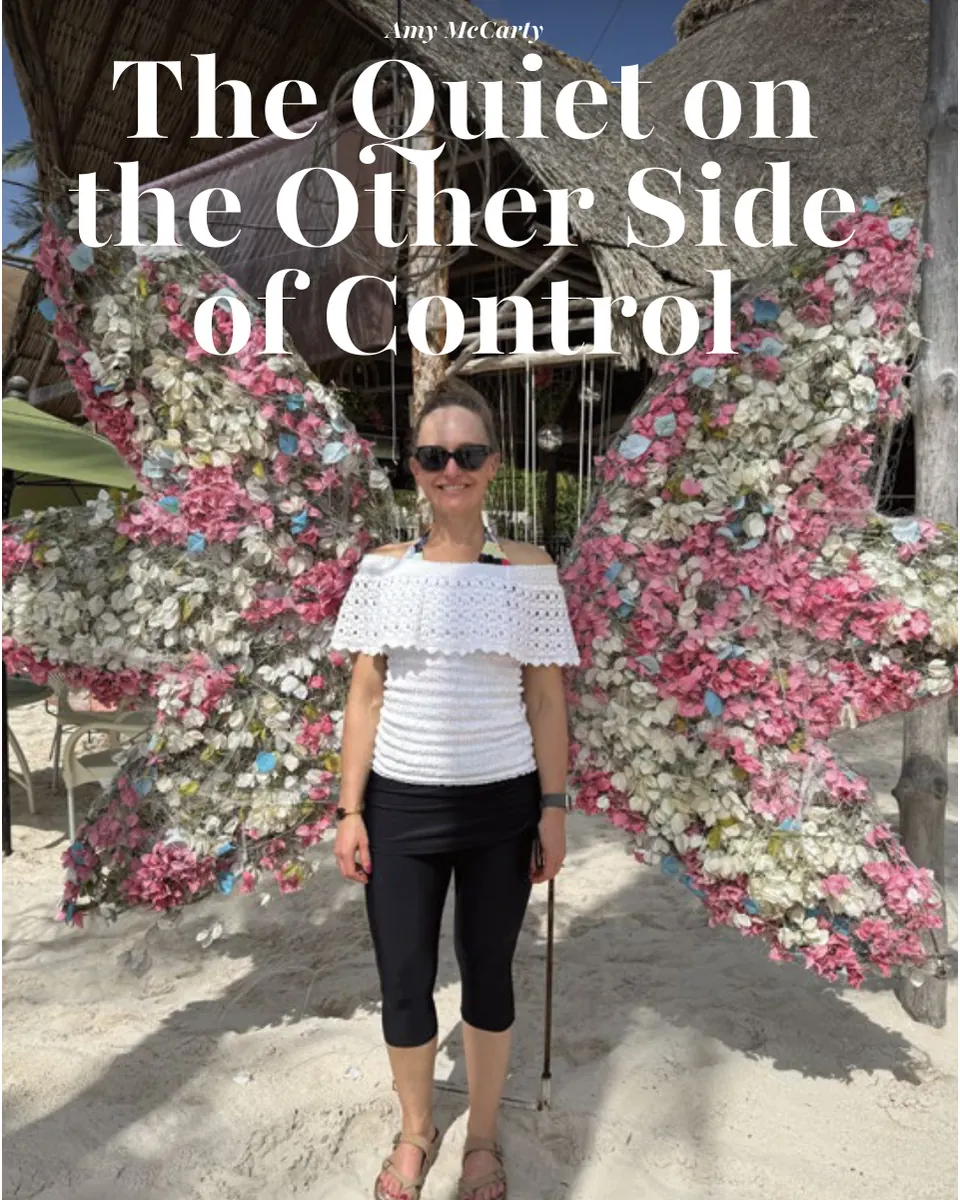
'm chasing something, and I don't know what it is yet." Amy McCarty said that out loud to her nutrition coach, and even as the words left her, some part of her already knew. She was in the best shape of her life, disciplined down to the gram, and somewhere along the way a thing that started from a good place had quietly taken over her whole mind. A mom of three, married twenty-one years, director of operations at an accounting firm, Amy looked entirely in control. Inside, the noise never stopped.
What she was chasing, it turned out, was something she already had.
This is the story of the morning she stopped chasing and started trusting God with the thing she had been holding most tightly.
It began, like a lot of these things do, somewhere good. She'd had three kids. She got back in shape. She loved the energy of it, the discipline, the way her body answered when she asked something of it. There was nothing wrong with any of the choices along the way. That is what made the line so hard to see.
"If I reflect back, it's such a small line," she says. She can point to the exact moment she crossed it, though she didn't recognize it as a crossing until much later. It was that sentence to her coach, the one about chasing. She said it, felt something flicker, and kept going anyway. "Sometimes you ignore," she says. "I probably knew. And then I just kept going."
What she was chasing, she couldn't name. That was the whole problem.
Somewhere in there, the thing stopped being something she did and became someone she was. Her identity attached to it. She was Amy, and Amy was disciplined, Amy was in control of exactly what fuel went into her body and exactly how much she asked of it. If the weight came back, so did the fear that she'd lost her grip on who she was supposed to be.
"I couldn't put on any weight, because then I wasn't in control, and then I wasn't maintaining who I thought I was supposed to be."
The tell was the noise. She could be home with her husband and three kids and the animals, conversations happening all around her, and not really be there. "I'm hearing what they're saying, but I'm not actually hearing what they're saying." Underneath ran a quieter, colder current, a question about whether she was worthy, whether she was living up to whatever she thought she owed. Her journal entries from that stretch keep circling the same wish. I want to be more present today.
Amy had been journaling for years by then, seven or so. One day she sat down and tried to sort her whole life into categories she could track over time, and what she landed on surprised her. Every category came back to a relationship. Her relationship with herself. With her husband. With her kids. With work. And underneath all of them, the one she has come to believe holds the rest together, her relationship with God.
"If I focus there," she says, "everything else starts to work better."
That was the thing she'd been getting backwards. She had wrapped her identity around health and fitness, and it could just as easily have been the career, or anything else. The danger was always the same. "If I tied my identity into my husband and I wasn't my own person, how can that marriage work?" You can't build a self out of a thing you're gripping.
Years earlier, a therapist had said something that stuck, precisely because she said it like it was nothing. Amy had mentioned struggling with body image for as long as she could remember, probably since she was a teenager. The therapist nodded and said everybody has something they struggle with.
"For me at that time, it was just, what? Other people? I thought this was me. I thought there was something wrong with me, that I was broken and I needed to fix it."
She wasn't broken. She was loved. It would take her a while to learn the difference, and longer to learn to live from it.
She didn't let go all at once. February was the big one, but it wasn't the first. She'd been quietly surrendering smaller things, the ones she hadn't wound her whole self around, working toward the one that would cost the most.
Leading up to that morning she had been praying on a single word.
Trust. "Trust that God knew what I needed," she says, "and it wasn't me." It sat saved on her phone's lock screen, where she can still find it. Ask God first. Trust his answers more than your instincts. Because her instinct was always the same. Track. Measure. Make sure.
That morning she was in her home office, where she starts her days, and she understood that trusting God was going to require something that genuinely scared her. So she opened the app she used to log everything, the one that told her whether she'd hit her numbers for the day, and she canceled the subscription and deleted it off her phone.
The relief came first. Then the panic. "Oh my gosh, what did I just do?"
The app was never really the point. Deleting it was the visible edge of something quieter that had been happening underneath: she was handing the thing over, and the One she was handing it to was God. The freedom didn't come from an emptied phone. It came from letting go.
And nothing collapsed. She didn't spiral. The desire she'd braced for never showed up. When the pull to track again surfaced, she leaned on the tools and people around her to reinforce what she already knew. She'd done deeper work with a therapist and sometimes used an AI assistant as a practical reminder not to fall back into tracking. But the tools weren't the source of the change. They helped her live out a decision that had already begun with surrender.
By later that day, she noticed the thing she can't stop describing. Space.
"Holy cow. There's room up there." The all-consuming hum had gone quiet, and into the quiet came a hunger she actually welcomed. "I just want to let go of everything," she remembers thinking. "Show me what else you can take, because I don't need it anymore."
What's left is not a life without discipline. She still works out. She still loves moving her body. What changed is the order of things, and what sits at the center of them.
For a long time, her quiet time, the journaling and the prayer, came after the workout, after the morning was already underway. Then people she trusted, a business group that folds faith into the work, kept telling her the same stubborn thing. Do the quiet time first. Roll out of bed and seek God before anything else. She had been asking them how surrender actually works, how you do it on an ordinary Tuesday, and the answer turned out to be almost insultingly small.
"You just do one thing." So now she starts her day with quiet time with God, before the workout and the rest of the day. She held to it on vacation last week. She didn't stop exercising. She just stopped putting it first.
The marriage got the room, too. Twenty-one years in,
“Amy doesn't just make things run smoother, she makes sure the people around her better along with the process. When she streamlines a workflow, she doesn't stop there; she takes the time to train the team members on it, so the improvement sticks with the team, not just the system. That same instinct shows up outside DBA's walls too: she coaches other accounting firm owners and shares the resources that help them grow. It's a quiet kind of generosity, the kind that shows up in her time and attention long before it shows up in any title. Titles describe a role. What Amy does describes a person who genuinely wants everyone around her, inside and outside the firm, to do better.” - Marcus Dillon, CPA, President,
Client CFO | Dillon Business Advisors, Co-Founder, President | Collective by DBA
she and her husband both know how easy it is to forget that your spouse is a whole separate person and not an extension of you, to assume that if you feel fine he must be fine over there. Clearing out the noise let her see him again, and choose him on purpose. It meant being more intentional about the small moments of connection and actually seeing each other. “We all can make a choice every day,” she says. “I choose you and I choose this.”
"I now believe and trust that I'm here for a reason," she says. The purpose of any given day is just to show up for whoever is in front of her, her kids, her husband, coworkers, clients, and ask what they need.
She is still learning to say all of this out loud. For the last year she has felt a repeated prompting to tell her story, and she has written those exact words in her journal at least ten times without knowing which story she meant. She is starting to think this is it, and that she is learning to tell it while she is still living it.
If you're in the chasing part right now, still gripping hard, she has one thing she wants you to hear.
"If you're chasing something and you don't know what it is, you aren't chasing the right thing."
She names where she is now as living loved. It doesn't mean she finally earned something. It means she is learning to live from a love that was already there, God's love, the kind she didn't have to chase or maintain or prove. It means she can be in the room and actually be in it. It means she has stopped auditing her own worth.
Text adapted from the print edition of Élevé.
 Middle of Nowhere, Center of Everything
 Solo to São Paulo
 Three Weeks in the Bush