Élevé · Issue 4 · Quietly Extraordinary
Running Back to Twenty-One
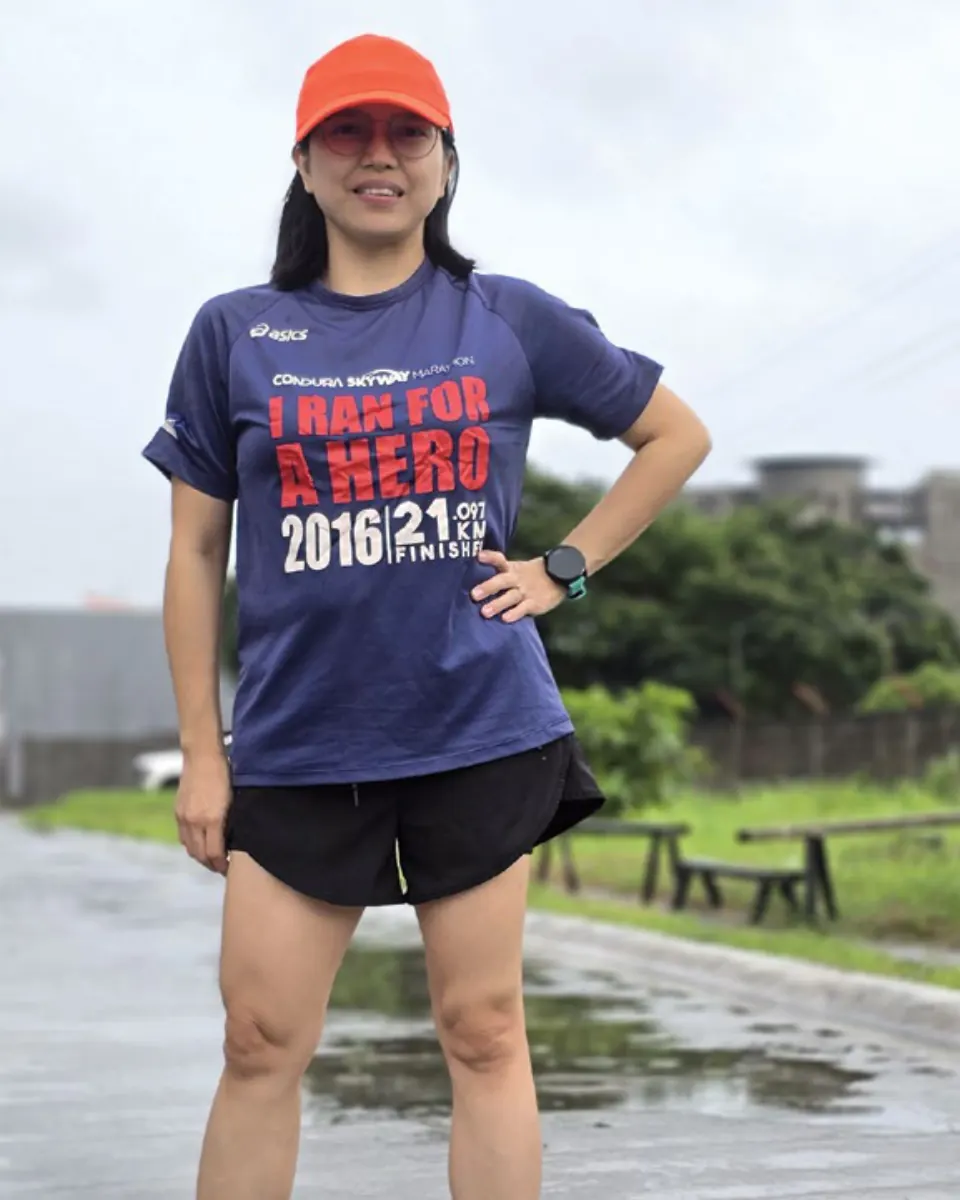
When people meet Regina Lindo, 39, mother of two, the one answering work messages at 6 a.m. and coaxing malunggay into a picky eater's soup, they don't tend to picture a distance runner. But she is one. In 2016, before marriage and motherhood, she finished a 21-kilometer half marathon. Then last year, at 38, with her lower back aching and her elder sister newly diagnosed with diabetes, she started again, this time not to prove anything, but to last. "I just realized that I'm not getting any younger," she says. Now she's training toward October's 12K, with that half marathon somewhere back on the horizon.
Here is the thing most people miss about Regina's running. It isn't a hobby she squeezed in. It's a decision she made about what kind of mother she wants to be.
"It's not just like wanting to lose weight," she says. "It became about being healthy and present for my family."
The turn came gradually, then all at once. First it was the weight she felt she was carrying, and a lower back that started to hurt, then hurt more often as 40 crept closer. Then it was her sister's diabetes diagnosis, and the realization that it ran in the family. Somewhere in there, the math changed. Her kids are still young. They still need her a lot. She wants to see them grow up.
So she went back to the one thing she knew her body could do.
Getting the run into the day is its own quiet feat of engineering. Regina wakes at 5 a.m. to prepare food for her eldest before school. She logs in for work at six. At ten she cooks for her youngest, an early breakfast and lunch folded into one, then wakes her, helps her into her uniform and shoes, and hands off to her husband for the school run. She logs out around 2:30 or 3 to pick up the kids. Only then, on the way home, does the run happen. Her husband drops her two to three kilometers out, and she walks and jogs the rest, up to an hour, before mom duties resume: dinner, backpacks, the next school day.
"If I want to exercise to happen, I have to be intentional," she says.
None of it is frictionless. On the hard days, the interruptions come mid-momentum: a meeting, a deadline, and two kids with questions and requests that don't wait. She switches out of work mode, then has to climb back in and find her focus again. Time management stopped being a nice idea and became the whole architecture of her life.
It doesn't have to be perfect. That's the part she keeps returning to.
There have been busy stretches when the exercise got pushed aside entirely, a week here, a couple of days there. What she refuses to do is let a missed week curdle into quitting. If she can only steal thirty minutes once or twice, she takes it. What keeps pulling her back out the door is partly the evidence written on her own body. When she started, the neighbors noticed. They saw the weight come off. Some of them began pointing other mothers her way.
"She can finish five kilometers like that," she remembers people saying. "You need to go with her."
Her youngest was the first to join. It started during summer, when Philippine schools are out, and Regina asked, almost offhand, if she wanted to come walk. The little girl lit up. Then it became a question Regina heard every day: "Are you going to walk later, mom?" A one-off turned into an every-other-day ritual, one or two kilometers of the two of them together, away from screens, talking.
Regina Lindo
"It's like a bonding for both of us," she says. Her husband is the reason any of it holds. There is no household help in their house, which means every time she trains, walks a route, or lines up for a race, someone has to have the kids. He does. He covers the registration fees when she signs up to run. He notices the changes and tells her so. And her health has quietly reshaped him too: she talked him into badminton on weekends, and now it's the whole family's game. The weekday jog stays mostly hers, sometimes with a child in tow. The badminton belongs to everyone.
The food shifted alongside the miles. She has cut sweets where she can and grown more mindful about what she eats, less about restriction than about paying attention. The proudest kitchen wins are small and specific. Tinola, the Filipino chicken soup with ginger and leafy greens, is a genuine victory in a house of fried-food fans, especially because her eldest, her pickiest eater, loves it and asks for extra malunggay. On busy days Regina can buy tinola from the carinderia down the road. Her daughter tells her she
That recognition rerouted something. The running stopped being only hers. likes her mom's better.
"As a mom, it's really a fulfillment for me." She is careful not to oversell any of this as balance achieved. Ask her directly and she says she's still trying, still getting there. Balance, to her, was never doing everything perfectly every day. It's a routine she can actually sustain, one that leaves room for her work, her family, and herself.
There is a reason she wants that on the record. Regina wants other working mothers to read her story and go easier on themselves.
"Don't be too hard on yourself," she says. "It's okay if your routine isn't perfect." Start small. Walk when you can. Move when you can. When you miss a day, start again. And ask yourself the question that reset everything for her: do I want to be there to see my kids grow up? For her the answer is yes, and that yes is the whole point.
She jokes that mothers get called super moms, then adds
“Regina is one of those people who quietly makes everyone around her more successful. She’s innovative, takes ownership of every project she touches, and is always looking for ways to improve how we work. Our operations team regularly relies on her to keep initiatives moving, and she consistently delivers.” - Argel Sabillo, Founder and CEO, dtlaCPA & heyapril the part that matters more to her: be kind to yourself, and don't feel guilty asking for help. Running is where she puts down what she's carrying.
"When I go for a run, I feel lighter," she says. "My mind feels cleaner."
The road ahead is measured in distances. The 12K is in October, and she's training for it now. If that goes well, 16 kilometers next year, and then, the year after, the number she keeps circling back to: 21 again. A second half marathon, at a different stage of life, with a different body and a different set of reasons than the woman who ran the first one in 2016.
That, more than any finish time, is what she's chasing. "My body and my age change," she says. "But I can still set personal goals and accomplish them."
Text adapted from the print edition of Élevé.
 Dogs for Good
 The Quiet on the Other Side of Control
 Middle of Nowhere, Center of Everything