Élevé · Issue 3 · Coming Back
One Goal, a Thousand Small Efforts
What started as a simple challenge evolved into something more enduring, a test of consistency, adaptability, and the mindset required
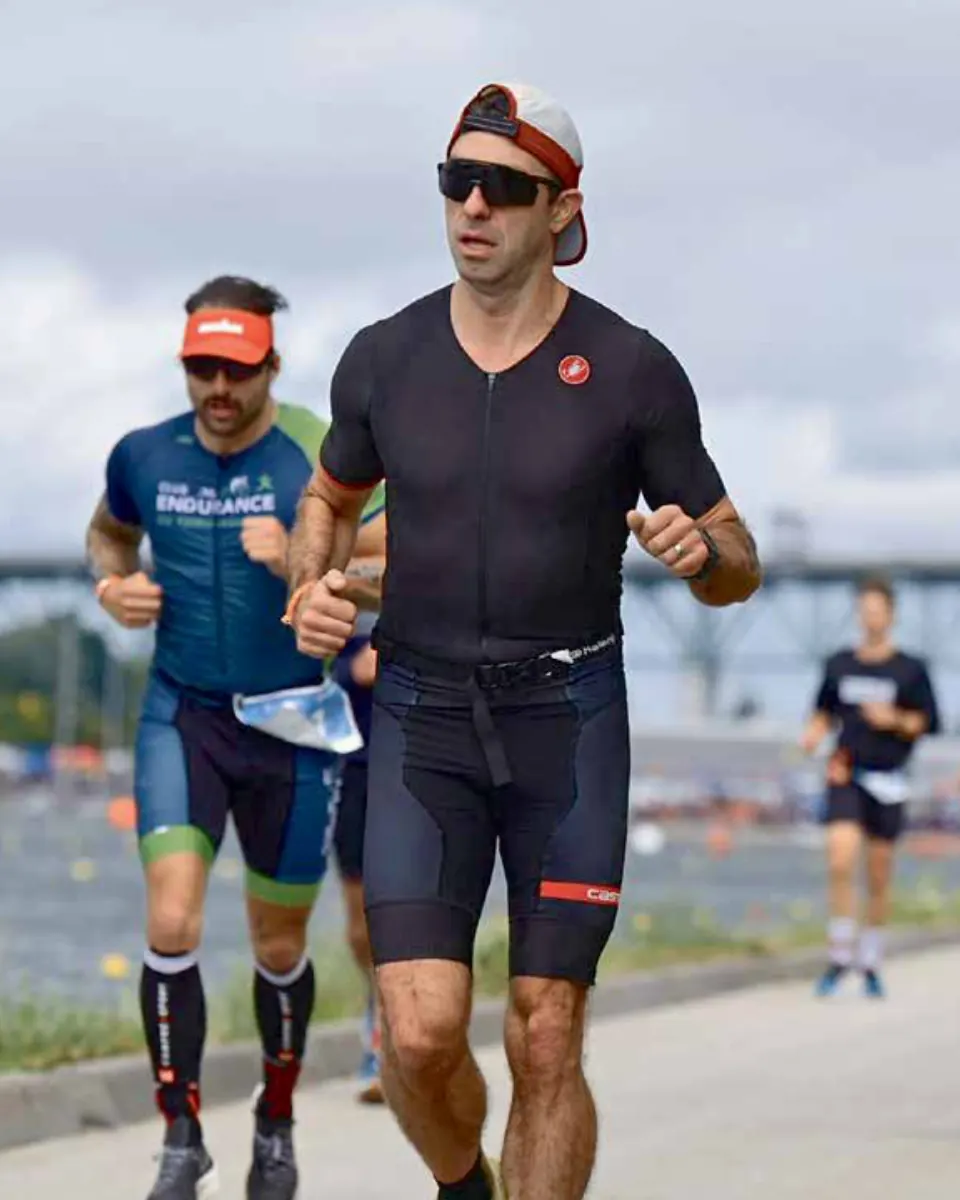
Ryan Lazanis doesn’t romanticize the idea of completing an Ironman. “It’s probably going to be painful,” he says plainly. But that’s part of the point. For Ryan, the goal has never been about crossing a finish line for the sake of it. It’s about finding something that feels hard enough to matter, committing to it, and seeing it through. “I like to find these new challenges and just try to overcome them,” he says. Even after being forced to slow down and rebuild, the goal hasn’t gone away. If anything, it’s become simpler. Just keep going, a little bit every day.
That instinct, to seek out challenge for its own sake, didn’t start with triathlon. Before the idea of an Ironman ever entered the picture, Ryan had already immersed himself in another demanding world. CrossFit gave him structure, competition, and a clear way to measure progress against others. There was always something to push toward, always a faster time or a stronger performance within reach. But over time, something shifted.
At a certain point, improvement became incremental. The gains were still there, but they came at a cost, more time, more energy, more effort for smaller and smaller returns. “When I feel that the level of effort that I have to exert to make a very small incremental improvement, it’s not very interesting anymore,” he explains. It wasn’t a loss of discipline or drive. It was something closer to curiosity. He had learned the system. He understood the game. And once he reached that point, the question became what was next.
The answer came casually, almost accidentally. A conversation with a friend over dinner turned into a joke, and then into a plan. They would try a triathlon. Nothing too serious at first, just a short-distance race to see what it was like. Ryan pulled out an old bike he hadn’t used in years, started running again, added swimming into the mix. It was new, unfamiliar, and that was enough to make it interesting.
He’s not new to the challenge either, having completed several triathlons over the past five years, most recently a Half Ironman in September 2024.
When his friend dropped out, the easy choice would have been to let the idea go with it. Instead, Ryan kept going. He had already committed, at least in his own mind. The date was set. The plan was in motion. “I just figured I’d keep going,” he says. It wasn’t dramatic. It didn’t need to be. The decision had already been made internally, long before there was anyone else to hold him accountable.
Training brought a different kind of challenge, one that was less visible but no less demanding. Unlike CrossFit, much of it was done alone. Hours spent biking, running, swimming, repeating the same movements over and over again. “A lot of it is really boring,” he says. “You’re on your own, and it’s kind of lonely.” There’s no crowd, no immediate feedback, no shared energy to carry you through. Just time, discipline, and the willingness to keep showing up.
And yet, within that repetition, something else began to take shape. Long rides without music or distraction created space, the kind that’s hard to find in a day filled with constant input. “I’ve had my best ideas during that quiet time,” he says. What might look, from the outside, like isolation or monotony became something more useful. A place to think. To work through problems. To arrive at clarity that didn’t come as easily anywhere else.
If the training itself demanded consistency, it also required a level of structure that touched nearly every part of his life. Preparing for a half Ironman meant balancing multiple disciplines at once, swimming, running, biking, often in the same day. Some sessions happened early in the morning before work, others late in the evening. Weekends were reserved for longer efforts, hours spent on a bike or out on a run. It wasn’t just a workout plan. It was a reorganization of time.
That kind of commitment comes with trade-offs. Time spent training is time taken from something else, family, friends, or other hobbies. “You can’t do it all,” Ryan says. Prioritizing the goal meant saying no to other things, even when they were enjoyable. It meant choosing the long ride over a round of golf, the early morning session over a slower start to the day. Not permanently, but consistently enough to make progress.
And then, just as the path forward seemed clear, everything changed.
A split-second moment, unexpected and entirely unrelated to training, brought everything to a halt. While out with his daughter, Ryan turned quickly and hit his head on a tree. At first, it didn’t seem serious. He carried on as usual, continuing with his routine, pushing through as he always had. But the impact lingered in ways he hadn’t anticipated.
The months that followed forced a different kind of discipline, one that looked nothing like the structured intensity of Ironman training. “The first six months, I was basically useless,” he says. Progress wasn’t measured in miles or hours anymore. It was measured in how he felt from one day to the next, in how much he could do without triggering symptoms that made even simple tasks difficult.
For someone used to pushing limits, the adjustment wasn’t easy. The instinct to keep going, to train harder, to maintain momentum, didn’t disappear. But ignoring the signals from his body only made things worse. “I didn’t listen to my body for like a good 10 months,” he admits. Eventually, the lesson became unavoidable. Progress now required restraint.
What replaced the old routine was something far less predictable. Effort had to be carefully managed, increased gradually, and pulled back when necessary. Some days allowed for more, others required less. “Sometimes my sessions are 10 minutes,” he says. “Sometimes it’s 30 minutes.” The consistency remained, but the scale shifted.
It changed the definition of progress entirely. Where once improvement meant going faster or longer, now it meant simply being able to do a little more than the day before, without setbacks. It meant paying attention, adjusting, and accepting that forward movement wouldn’t always be linear.
In some ways, the experience added a layer of meaning to the original goal. The Ironman didn’t disappear. It just moved further into the distance, no longer tied to a specific date, but still very much present. There’s no elaborate timeline, no rigid expectation. Just a steady return, one small effort at a time.
That same mindset extends beyond training. Building a business that allows for this kind of pursuit requires intention, the ability to design something that supports not just work, but life outside of it. “You need a business that gives you that kind of freedom,” he says. Without it, the hours required for training and now for recovery wouldn’t be possible.
The Ironman, in that sense, becomes more than a physical challenge. It’s a reflection of how he approaches everything else, understanding the system, committing to the process, and adjusting when necessary. Not abandoning the goal, but reshaping the path toward it.
There’s still uncertainty ahead. Whether he completes one Ironman or stops after the first, whether it happens next year or later, remains to be seen. “I’ll test the waters,” he says. The outcome isn’t fixed, and that’s part of what makes it sustainable.
What remains constant is the approach. The willingness to show up, even when the effort feels small. The discipline to keep going, even when progress is slow. And the understanding that sometimes, the most meaningful version of a goal isn’t the one you start with, but the one you continue to pursue, even after everything about it has changed.
Text adapted from the print edition of Élevé.
 “I Think the Biggest Thing Is Giving Myself Permission”
 A Lifetime of Saturdays, One Stadium at a Time
 The Kind of Dream You Don’t Check Off