Élevé · Issue 3 · Coming Back
A Lifetime of Saturdays, One Stadium at a Time
What began as a childhood ritual in Ohio has grown into a shared dream: traveling the country,
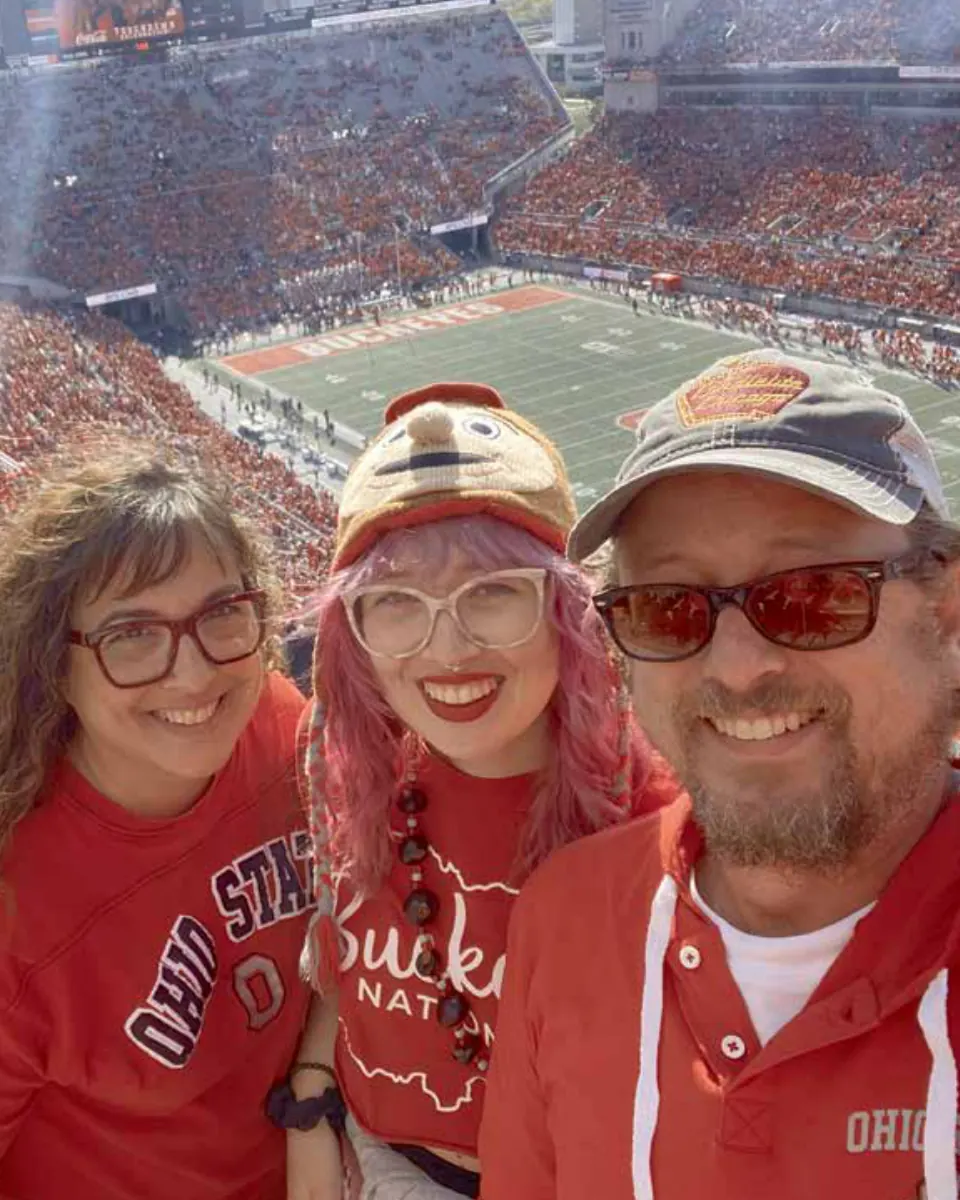
Melissa Miller Furgeson doesn’t remember a single moment when college football began for her. It was simply always there. Growing up in Ohio, weekends revolved around games, with her dad throwing passes in the backyard and her parents holding high school season tickets year after year. What she carries from that time isn’t just the game itself, but the feeling around it, the sense of being part of something shared, something alive. Now, decades later, that same feeling has taken on a new shape: a dream she shares with her husband to visit every major college football stadium in the country.
It’s a goal that feels expansive, but also deeply familiar. Not a departure from her life, but a continuation of it.
As a kid, football looked like afternoons outside, her dad stepping in as quarterback while neighborhood friends gathered on the acre of land where she grew up. It looked like weekends filled with games on TV, her dad an “avid, maybe rabid” fan of Ohio State and the Cleveland Browns. There isn’t one defining memory she points to. Instead, it’s the repetition of it all, the steady rhythm of seasons, games, and time spent together that shaped how she understands connection.
What has stayed with her most is the feeling inside the stadium. “You have this group of friends who you’ve never met,” she says. “You’re all just as excited to be in this electric environment.” It’s a kind of collective energy that doesn’t require introduction or explanation. People arrive separately, but once the game begins, they move together, cheering, reacting, experiencing it all in sync.
She’s found versions of that feeling elsewhere, in accounting conferences and large gatherings where people come together around a shared interest. But in a stadium, it becomes something more immersive. There’s a moment she describes, walking through the tunnels beneath the stands, where everything is still contained, unseen. And then it opens.
“It opens up in front of you like this grand sort of cathedral of sport.”
The field, the crowd, the scale of it. The band playing, the mascots, the traditions layered into every part of the experience. It’s not just a game unfolding. It’s an event, something orchestrated and communal, where the atmosphere carries as much weight as the score.
That distinction matters to her. Watching at home is about the game itself. Being there is about everything surrounding it, what she calls “all of the hullabaloo.” It’s the details, the rituals, the shared anticipation, the way the energy builds and moves through the crowd.
About five years ago, as she and her husband began thinking about what life might look like once their three kids were grown, that feeling resurfaced as something to build toward. Their youngest is now in college, and with that shift came a question: what comes next?
They knew they wanted to travel. But more than that, they wanted a reason to travel, something that would shape where they went and why.
College football became that reason.
What began as a conversation turned into a plan. They considered buying an RV, then decided renting one made more sense. The idea was to build trips around games, to move through different parts of the country with something anchoring each stop. National parks, new cities, long weekends structured around stadiums they had never seen before.
So far, they’ve visited 12. The pace is intentional, shaped by full-time work and fall schedules that don’t easily open up. Two or three games a season, trips that sometimes double as visits to their kids. When they go to Iowa, for example, it’s not just about the stadium, but about seeing their youngest, who now has her own season tickets.
There’s no urgency to complete the list. If anything, the slow pace is part of the appeal.
Along the way, something unexpected has shifted for Melissa. She assumed she would stay loyal to her own team, Ohio State, and that every game would be filtered through that lens. Instead, she’s found herself widening her perspective.
“I did not expect that I would be so excited about watching other teams that weren’t my team,” she says. “But since we started doing this when our kids were the age of these players, I’ve felt this sense of, they’re just like my kids.”
It changes how she watches. The players are no longer just part of a team she’s for or against. They’re individuals she finds herself rooting for, wanting to see succeed, feeling connected to in a quieter, more personal way.
That same mindset shapes how she shows up in the stadium. She doesn’t leave early. Even when the outcome feels certain, even when her team is losing, she stays.
“We’re there to support the team,” she says. “It’s not just entertainment.”
The experience, for her, is something to be seen through. Something shared, not consumed.
Some of the moments that stay with her most aren’t tied to the outcome of a game, but to the people around her. At a Northwestern game, she and her dad sat next to opposing fans who had brought homemade chocolate chip cookies and offered to share them, even though Melissa’s team was winning. In another game, she was in the stadium when a quarterback suffered a serious injury. Before anything was announced, the entire crowd seemed to understand at once. The energy shifted, moving into a collective silence that transcended rivalry.
These are the moments that define each stadium for her. Not just the size or the traditions, but the way people show up inside them.
Still, the traditions matter. Ohio State’s Script Ohio remains one of the most meaningful. The marching band spelling out “Ohio” in cursive across the field, the precision of it, the way it draws the crowd in. Once a year, alumni join, creating multiple scripts at once. It’s something she has seen many times, and yet it never loses its impact.
There are still stadiums she’s looking forward to. Penn State, with its size and the “white out,” where the entire stadium dresses in white. It’s something she has watched from afar and wants to experience from within, to feel the scale of it in person.
And then there’s the Rose Bowl. Growing up in Ohio before the playoff system, I saw the Rose Bowl game as the ultimate goal for Big Ten teams. “That was the ultimate prize,” she says. Even now, that meaning hasn’t shifted. Being there would be less about checking off a stadium and more about stepping into something that shaped how she understood the sport from the beginning.
Their trips have taken on other layers, too. Food has become part of the experience, with the two of them seeking out Michelin Bib Gourmand restaurants along the way. Each destination becomes more than a game, more than a stadium. It becomes a way of exploring, of paying attention, of building something shared across time and place.
At its core, the dream is simple.
“It represents my sense of adventure and pursuit of fun and connection,” Melissa says.
But beneath that simplicity is something more enduring. A continuation of what began in childhood, carried through years of routines and responsibilities, now reshaped into something that belongs entirely to this next phase of life.
A way of staying connected, to each other, to the past, and to that feeling she has been returning to all along.
Text adapted from the print edition of Élevé.
 The Kind of Dream You Don’t Check Off
 The Lesson She Learned Too Late May Change Everything for the Next Generation
 It’s Something I Could Never Let Go Of