Élevé · Issue 3 · Coming Back
“I Can’t Wander Out of It, I Have to Be Intentional”
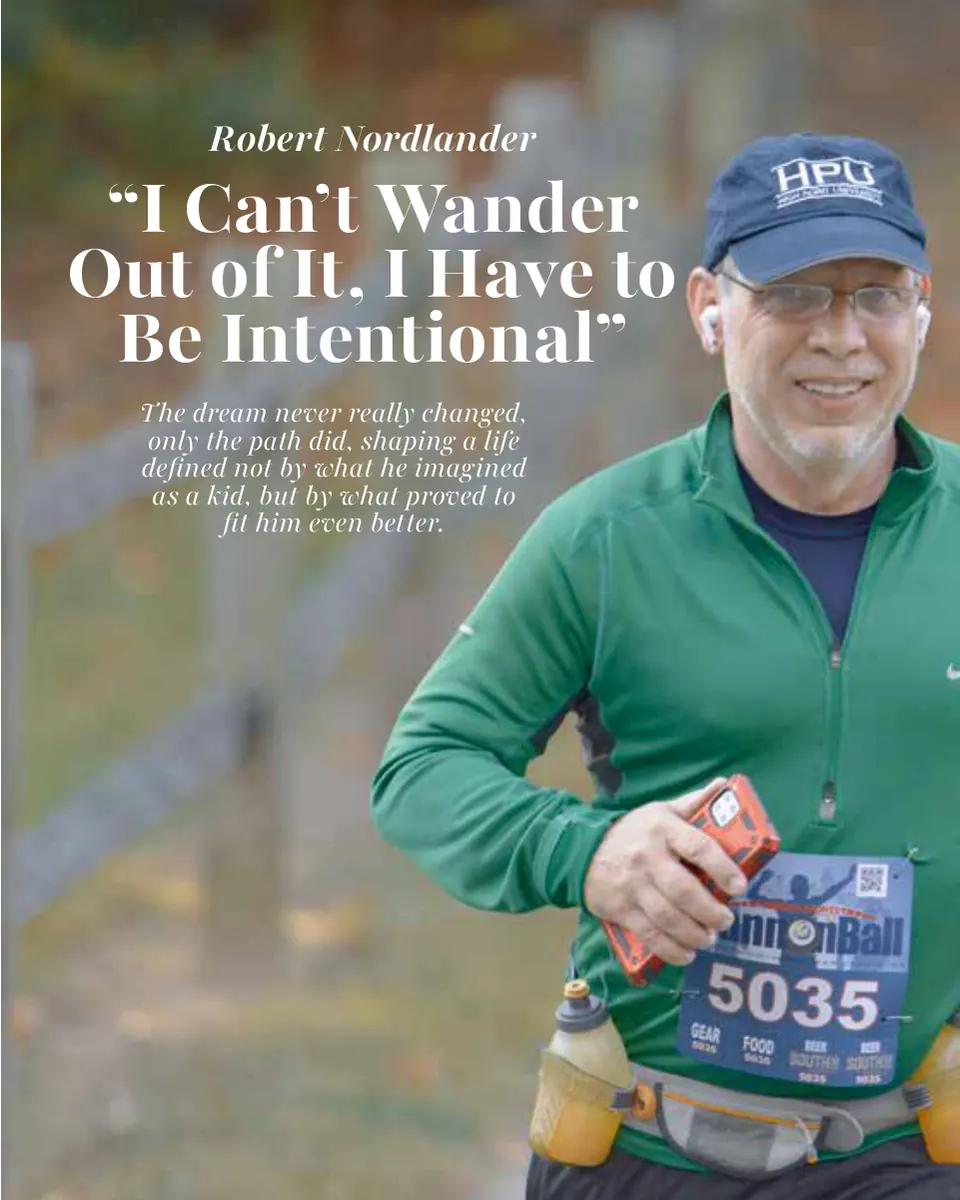
As a kid, Robert Nordlander imagined a life defined by motion, risk, and purpose, the kind he saw on shows like Chips and Miami Vice, where the people chasing danger always seemed just a step ahead of it. “I always liked to be the guy that rushed into burning homes,” he says, describing a pull not just toward adventure, but toward being the one who shows up when it matters most. For years, the dream was clear: become an FBI agent, chase bad guys, live a life that felt as meaningful as it did unpredictable. But the version of that dream Robert ultimately built didn’t look exactly like what he imagined. In some ways, it became something far more aligned than he ever expected.
The plan, at least in the beginning, was surprisingly strategic. Robert knew early on that the FBI often recruited accountants and lawyers, so following in his father’s footsteps, he chose accounting, not because it was the dream itself, but because it could be the door into one. It was a practical decision layered underneath something much more instinctive, a desire to step into situations where something was at stake, to be the person who ran toward problems instead of away from them.
That instinct showed up long before his federal career ever began. As a teenager, he became a junior volunteer firefighter, drawn not to the idea of danger itself, but to what it represented. “Sixteen years old, yeah, sign me up,” he recalls. Even then, there was a pattern forming, one that would follow him through every stage of his life.
After graduating college early, before he was even old enough to fully step into federal law enforcement, Robert stayed the course in accounting. Life moved forward in the way it tends to do, steady, practical, building. But the dream didn’t disappear. It waited. And when he reached a point where staying put no longer made sense, he made a decision that would shape everything that followed.
“If I’m going to do it, now’s the time to do it.”
He applied everywhere: the FBI, Secret Service, DEA, IRS. It wasn’t about one specific badge anymore. It was about stepping into the kind of work he had always imagined for himself. The IRS Criminal Investigation division was the one that called him back.
It wasn’t the FBI. But it was something else entirely.
What he found there was a version of the dream that felt sharper, more focused, and unexpectedly more aligned. Instead of splitting his time across different types of cases, he spent twenty years immersed in white collar crime, using accounting not as a stepping stone, but as a tool. It was, in many ways, the exact intersection he hadn’t known to look for.
“It was a great marriage between law enforcement and accounting,” he says. “That’s all you do, is use your accounting skills in a law enforcement function.”
The work gave him what he had always been drawn to, the pursuit, the problem solving, the sense that what he was doing mattered. But it also gave him something the original dream may not have. Stability. A sense of place. A life that didn’t require constant movement or uprooting.
With the IRS, he could stay in one city. Build a life. Raise a family without the uncertainty that often comes with other federal roles. Looking back, that tradeoff doesn’t feel like a compromise. It feels like clarity.
“I didn’t feel like dragging my family around the country because I wanted a career,” he says.
That perspective, grounded and deliberate, is something that seems to have deepened over time. Because while the early version of his dream was about action and momentum, the version he lives now is shaped just as much by intention.
It’s a word he returns to often. Not as a concept, but as a practice.
“There’s times in your life where you realize this carries more weight than you thought it did,” he says.
In his thirties, it showed up in his work. The realization that talent alone wouldn’t carry him as far as consistency would. That being dependable mattered more than being the smartest person in the room. That showing up, over and over again, was what built a career.
“You don’t have to be the smartest guy in the world,” he says. “You just have to be consistent and dependable.”
Over time, that same principle extended into other parts of his life. Health. Finances. Relationships. Giving. Areas where it’s easy to drift without noticing until the impact becomes unavoidable.
You don’t accidentally build the life you want. You choose it, repeatedly, often in small, unremarkable ways.
That idea reshaped how he approached giving in particular. Something he had always done, but not always with intention.
“I was giving, but I wasn’t being intentional about it,” he says.
So he changed it. Not in a dramatic way, but in a deliberate one. Setting aside money specifically to give away. Looking for opportunities instead of waiting for them. Turning something passive into something active.
It’s a shift that mirrors the larger arc of his life. The move from instinct to intention. From chasing a version of a dream to fully understanding what made that dream meaningful in the first place.
Because at its core, the desire was never really about the title. It wasn’t about being an FBI agent specifically. It was about something more fundamental.
Helping people.
Stepping in when it mattered.
Doing work that felt like it had weight to it.
Even his time outside of federal work reflected that. Serving on city council. Riding along with police officers to better understand their work. Eventually becoming a volunteer deputy, spending nights and weekends doing the kind of work he had been drawn to since he was a kid.
“I’ll play cops and robbers on weekends,” he says, half joking, half serious.
But underneath it is the same throughline. A life built not around a single role, but around a consistent desire to serve.
That perspective has also been shaped by what he’s seen along the way. The realities of law enforcement that don’t show up in television versions of the job. The complexity of people. The patterns that repeat.
“There’s truly evil people in this world,” he says. “But a lot of it is alcohol or drug related.”
Seeing both sides, the prosecution and the defense, added another layer. A more nuanced understanding of justice. Not as something absolute, but as something that requires care, precision, and restraint.
“I can’t make a guilty person innocent,” he says. “All I can do is make sure their rights haven’t been violated, and they’re not getting steamrolled.”
It’s a perspective rooted less in judgment and more in responsibility.
And when he thinks about what all of it adds up to, the career, the choices, the evolution of how he sees the world, the answer isn’t complicated.
It’s not about titles or accomplishments. “If I had, at the end of the day, I hope that people think that I treated them fairly,” he says. “That I was kind to them.”
There’s something quiet about that answer. Something that doesn’t try to impress or overreach.
Just a simple measure of a life well lived. For Robert, the dream may have started with flashing lights and high-stakes pursuits. But the version he built is defined by something steadier.
Not just what he did. But how he chose to do it.
Text adapted from the print edition of Élevé.
 “Why Are You Waiting?”
 Not for Fame, Not for Numbers, Just to Feel Like Himself Again
 The Dream That Waited 20 Years