Élevé · Issue 2 · Rooted in Resilience
The Weight of Belonging
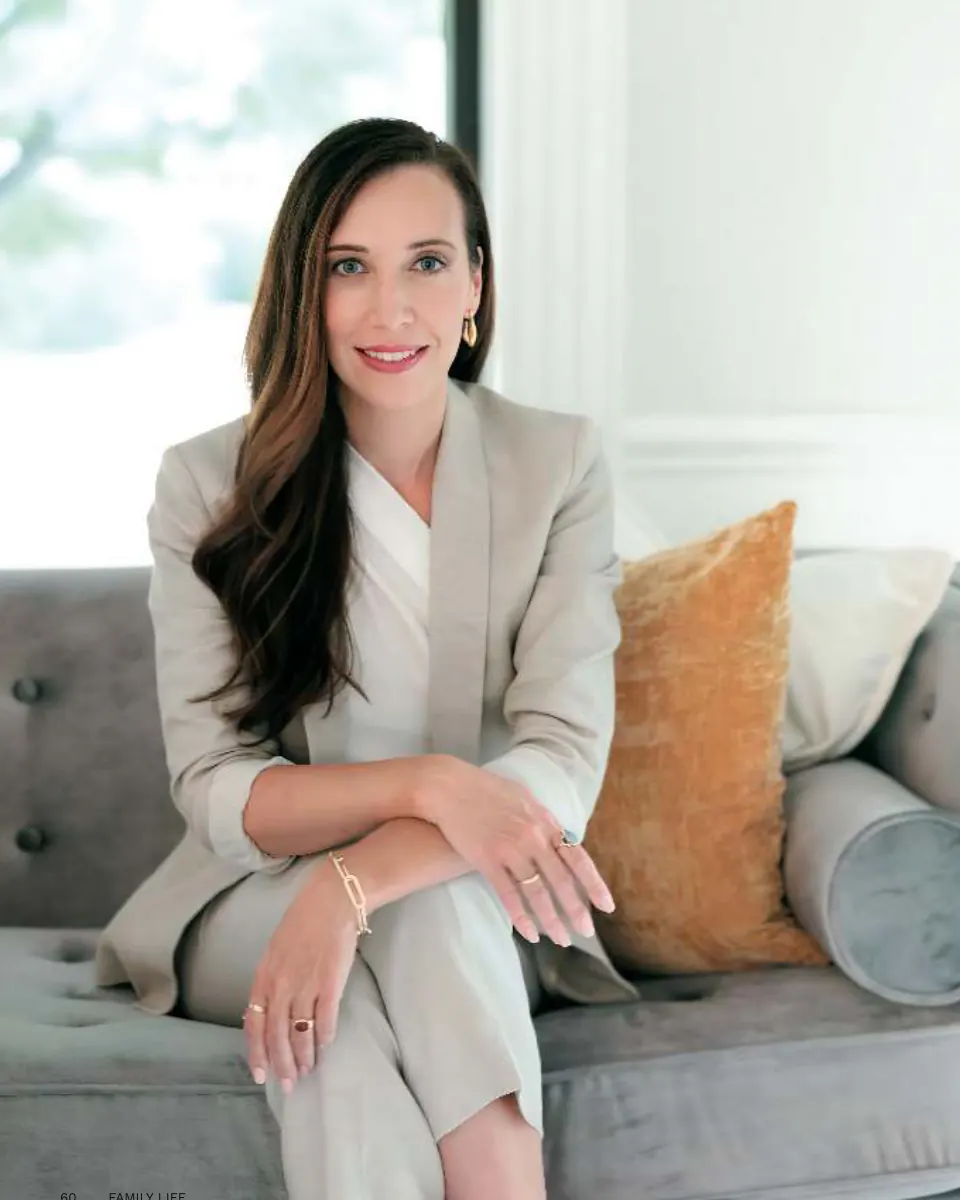
When Questian Telka welcomed her second son into the world, she expected the ordinary chaos of new motherhood: sleepless nights, tiny fingers curled against her chest, the blurred days of caring for a newborn. Instead, she woke to a nightmare she could never have prepared for. Her baby arrived by C-section, his tiny body purple, his breath uncertain. Doctors rushed him away before she could hold him. “I didn’t even see him for hours,” she recalls. “I don’t think I held him for almost a week.” Within days, the diagnosis began to take shape: Apert syndrome, a rare condition that affects roughly one in 150,000 births. The sutures of his skull were fused. His fingers and toes webbed together. Feeding was nearly impossible with a cleft palate. A malrotated bowel required emergency surgery just one week into his life. The six weeks that followed were a blur of monitors, IV poles, and the kind of fear that makes time collapse. “It felt like I came out of my body,” she says. “Like I was floating above myself, watching this all unfold. I was in shock.” That shock never fully receded, it reshaped her life.
A childhood of surgeries
By the age of two, her son had already endured most of his ten surgeries. There would be cranial procedures to allow his skull to expand, operations to separate his fingers, treatments to repair his palate. Feeding was a battle. Breathing was precarious. Then came another crisis. At age six, after a complication from that early bowel surgery, he developed a life-threatening obstruction. The month-long hospitalization that followed pushed his tiny body to its limit. “He was septic. He was so sick. He was hooked up to every machine you could think of,” Questian says quietly. Twice, she nearly lost him. Twice, she didn’t. Her gratitude is still edged with disbelief. “I can’t believe what he’s been through,” she says. “He’s remarkable.”
The ripples of one life
Raising a child with a rare condition does not stay neatly in the box labeled “home.” It ripples outward, into work, into friendships, into identity. For Questian, it reshaped everything. Before his birth, she hadn’t thought deeply about disability or inclusion. Afterward, she couldn’t stop. “I didn’t realize how many families were living this reality,” she explains. “How many kids had disabilities. How often they were ignored or sidelined. Once you see it, you can’t unsee it.”
Her business choices reflect that awakening. She built a firm that prioritizes boundaries, flexibility, and inclusion. She became involved with nonprofits focused on vocational opportunities for people of all abilities, helping teenagers transition into adulthood with dignity and work that fits. The personal became political. Her son’s story gave her clarity about the spaces she wanted to create, not just for him but for anyone who has ever felt shut out.
DEI as a calling
In an era when diversity, equity, and inclusion (DEI) can sound like corporate jargon, Questian speaks about it with lived urgency. “Everybody wants a sense of belonging,” she says. “In the workplace. In school. In life. That’s universal.” Representation, she argues, isn’t optional. It’s survival. When employees see leaders who look like them, clients who share their experiences, or colleagues who understand their struggles, it shifts what feels possible. “Belonging is often the number one reason people choose a job,” she notes. “More than salary. They want to feel seen.” Her son’s education has made the point even sharper. Inclusion, she insists, benefits everyone. “We want him in an inclusive learning environment as much as possible with his peers. It’s not just helpful for him, it’s helpful for other kids, too. Everybody grows when everybody belongs.”
Feminism in practice
Long before her son’s diagnosis, Questian considered herself a feminist. “I was born a feminist,” she says with a wry smile. “I’ve always been a girl’s girl, someone who wanted to elevate women and fight for them.” Motherhood, particularly motherhood of a child with a disability, fused that feminism with action. It gave her urgency, direction, and a willingness to use her platforms for others. That’s what inspired the She Counts podcast she co-created, a project designed to amplify voices too often ignored in business and beyond. “I want to fight for everybody who doesn’t have the same privileges I have,” she says. “We have to make sure everyone has a voice and a seat at the table.”
The price of courage
None of this came easily. Boundaries became survival tools. “I learned to manage my energy, my stress,” she explains. “Stress is one of the biggest triggers for flare-ups, for me, for him. I had to learn when to say no.” She admits the early years drained her dry. “I’ve almost cried it all out,” she says. “Now, when I tell the story, I sound logical. But the truth is, it was the hardest season of my life.”
A slow parade
Her son, now seven, greets each school day like a festival. As their car pulls up to the drop-off line, he rolls down the window and waves to every teacher, every aide, every student within sight. His greetings ripple outward, turning the carpool line into a makeshift parade. “It makes their day,” Questian says. “And it makes mine.” It is the small rituals, the parade, the way his classmates adapt, the shared laughter that remind her why belong- What does the future hold for her son? It’s a question that keeps her moving. She wants workplaces that will see his abilities before his diagnosis. She wants a society that makes space for difference, not as charity but as strength. The good news: the accommodations that make work possible for someone with a disability often benefit everyone. Flexible schedules, better communication, accessible spaces, all ripple outward, just as her son’s presence has rippled outward into her life. “He’s just like any other little boy,” she says. “He loves garage doors and buses. He dreams. He wants to belong.”
The courage to belong
Questian’s story is not tidy. It is messy, painful, and deeply human. It is also a study in how personal crisis becomes collective responsibility. Her son’s survival forced her to rebuild. His joy demanded she reimagine. His difference taught her the urgency of inclusion. If there is a throughline, it is courage, the courage to face machines and monitors, to sit in hospital corridors, to rebuild a business with boundaries, to create platforms for voices beyond her own. “We have to keep moving the cart forward,” she insists. “For our kids. For all of us.” Her son’s parade each morning is proof that it’s working. Proof that belonging can be built, one wave at a time. ing matters so much. It’s not theory. It’s lived truth.
Looking ahead
Text adapted from the print edition of Élevé.
 The River Knows the Way
 Breaking the Silence
 Unseen Battles