Élevé · Issue 4 · Quietly Extraordinary
His Miracle Smile
A decade, nine surgeries, and one mother learning that the hardest part was never the medicine, it was watching
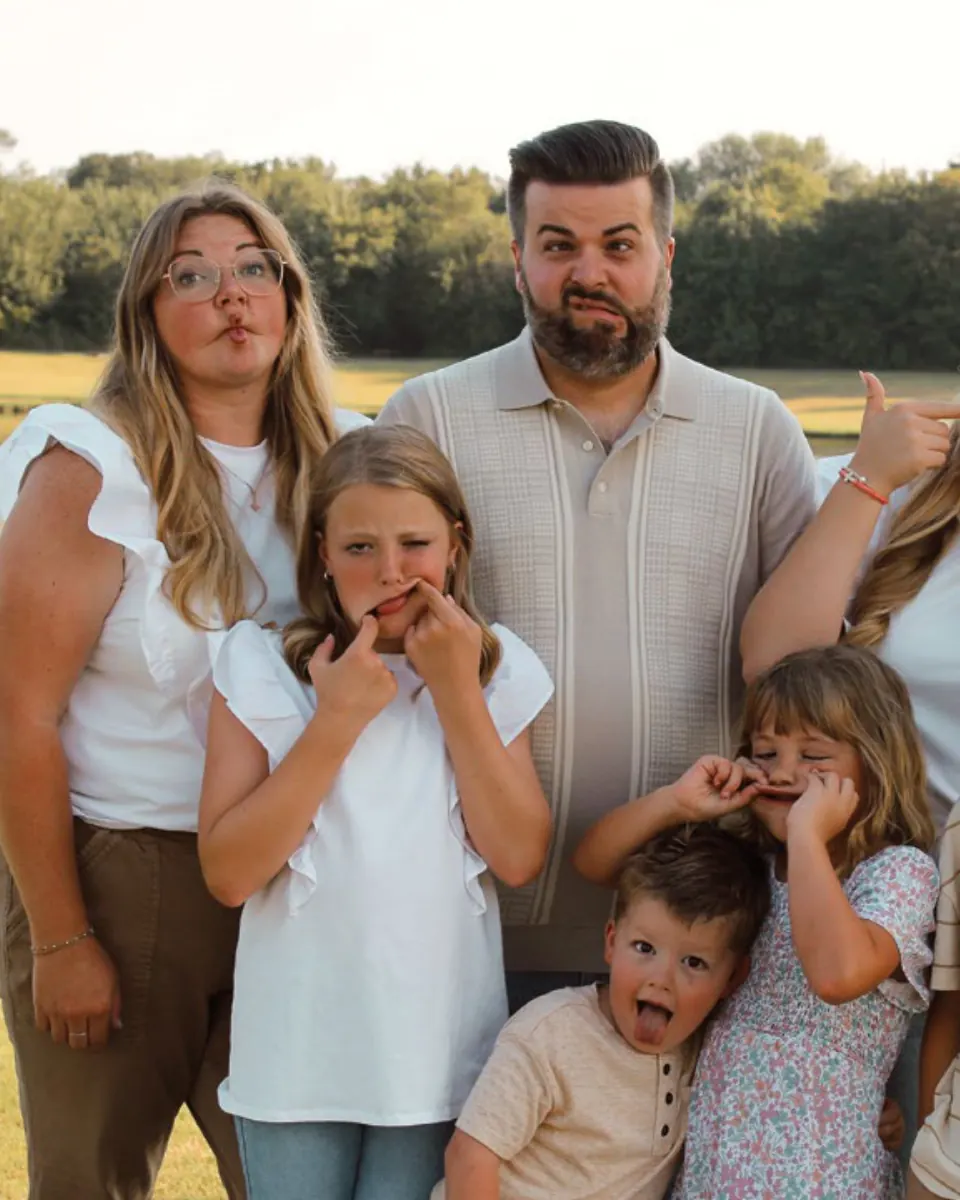
Jess Bentley remembers the exact moment she knew something was wrong. She was twenty weeks pregnant with her third child, lying still for what should have been a routine anatomy scan, when the technician started stalling. "They just kept saying, I can't get a really good look at a few things," Jess recalls.
Then the technician left the room to get the doctor.
"I've never had that happen," Jess says. She had an inkling already.
The doctor came in and told her, gently, that her baby appeared to have a cleft, though they didn't yet know how severe. He also told her there were options, including ending the pregnancy, if she couldn't handle it.
Jess didn't hesitate.
"No, I want this baby. We waited for him. I'm so excited for him."
She had some frame of reference. Her own sister had been born with a minor unilateral cleft, just on the lip, corrected with a single surgery. Jess was four at the time, and years later, she remembered her sister confiding how something as small as lipstick could make her feel like she stood out. But a mild case in a girl was not the same as what the doctors were describing now.
"I was just super overwhelmed," Jess says, "and I knew nothing. Even though I know a tiny bit, I have no clue what this is going to hold."
When her son was born, the reality was more severe than she'd braced for: a bilateral cleft, complete on both sides, running from his lip through his palate to the back of his throat. And yet, in the same breath, there was relief. He was healthy, with no other developmental issues, the biggest of her babies so far.
"There's a lot of kids that have cleft lip and palate that end up having other differences," Jess says. "I was grateful that he was there and a good size."
The joy didn't last uninterrupted. Shortly after birth, his breathing pattern worried doctors enough that he was rushed to the NICU, a habit of holding his breath when upset that, Jess says, he still has today.
His name is Sawyer, and he was nine days old for his first surgery, a procedure to remove a tooth bud he'd been born with. Jess's husband went in with him. Jess stayed outside.
"I could just hear him screaming," she says. "There's nothing you can do. That's my baby. They have no clue what's happening to them."
It would not be the last time she sat outside a door like that.
Three months later came the surgery that closed his lip and palate and placed a prosthesis in the roof of his mouth. When Jess and her husband were brought back to see him, swollen from anesthesia, his cry sounded different, his face looked different.
"It didn't look like my son," Jess says. "I thought, this isn't him."
It was the ear tag, a small marking he'd been born with, that told her otherwise. "Then I was comforted," she says. "But he sounded completely different."
There would be nine surgeries in total over the next decade: procedures on his soft palate for speech, the slow correction of a top jaw that had formed in three separate pieces instead of one, the removal of extra teeth, the joining of a lip that had been split in thirds.
One of the hardest came when Sawyer was around eighteen months old, old enough to understand he was being taken from his parents, but too young to understand why.
"He just started crying and reaching for us," Jess remembers. "That was one of the hardest things."
Layered onto the surgeries themselves was the logistics of them. When the family moved from Utah to Texas, Jess had to find an entirely new surgical team, essentially "break up" with a surgeon they'd only just met because his plan didn't match the pace they'd agreed on with Sawyer's original team. She spent roughly six months researching before finding the right fit in Dallas, learning along the way to ask pointed questions about a surgeon's flexibility: whether they treated every case identically, or adjusted to the child in front of them.
Then came a different kind of surgery, the emotional kind.
Sawyer started kindergarten during COVID and wore a mask his entire first year. The next year, when masks came off, he didn't want his to.
"What if these people I've become friends with see my face and don't want to be my friend anymore," he told his mother.
Jess thought of the movie Wonder, of a mother's encouragement to a son afraid to be seen. She told Sawyer he was amazing, that the people worth having around him would accept him as he was.
"The people that are mean to you are not the people you want to be around."
What has struck Jess most, watching Sawyer grow through all of it, is his instinct to turn hard things into something lighter. After one surgery, his head still wrapped and his face swollen, he was dancing to make his sisters laugh.
"He just likes to make everything funny all the time, regardless," Jess says.
On the baseball field, where he plays now, she sees the same thing: a kid who is competitive but spends most of his energy cheering everyone else on.
"He gets to give people the love he wants them to feel, so they never feel the way he has."
Jess eventually started an Instagram account, @hismiraclesmile, after finding that the parent forums recommended by doctors were either frightening or too clinical to be useful. She wanted a place that showed the actual day to day: things like the fact that Sawyer's food would come out of his nose as a baby because his palate wasn't yet closed, details no one else was sharing. Today the account has around 700 followers.
"I don't want somebody else to feel so alone in this," she says.
The lessons have rippled outward. Watching her son face teasing has
“More than anything, Jess is genuinely one of the kindest, most positive people I know... truly a ray of sunshine on our team. She shows up for people, celebrates them, encourages them, and brings an energy that you just can’t put in a job description. We’re incredibly lucky to have her.”
- Ashley Ford, Business Owner, Pretty Penny LLC
made Jess quicker to speak up when she sees someone else being treated unkindly. It has also softened her toward the people doing the teasing.
"Hurt people hurt people," she says. "They have their own stuff going on."
And it has shaped how she raises her other four children: an awareness, she says, of how fragile and short life actually is, and a determination to meet her kids with compassion rather than rigidity.
Sawyer has one more surgery ahead, a jaw and nasal surgery scheduled for when he turns fourteen. Jess feels something closer to peace about it than she once did. He can tell her now when something hurts. He understands what's happening to him. The recovery, she knows from experience, will take about a month.
"It always works out," she says. What she hopes he carries forward isn't the surgeries themselves, but what sharing them has done. Sawyer has met two older kids who also grew up with clefts, and looking up to them has shown him what's possible on the other side.
"I hope he understands that being vulnerable and sharing his experiences helps people feel seen and brings people together."
It's a lesson Jess has been living out loud for ten years, one surgery, one hard conversation, one small act of courage at a time. weeks pregnant when Jess learned something was different old for Sawyer’s first surgery total surgeries by age ten months spent finding a new surgeon after the move to Texas
Sawyer’s age at his next scheduled surgery followers on …@hismiraclesmile
“I don’t want somebody else to feel so alone in this.”
- Jess Bentley
Text adapted from the print edition of Élevé.
 Four Counts In, Four Counts Out
 This Is Exactly Where We’re Meant to Be
 From Banana Hats to Flight Lines