Élevé · Issue 4 · Quietly Extraordinary
Four Counts In, Four Counts Out
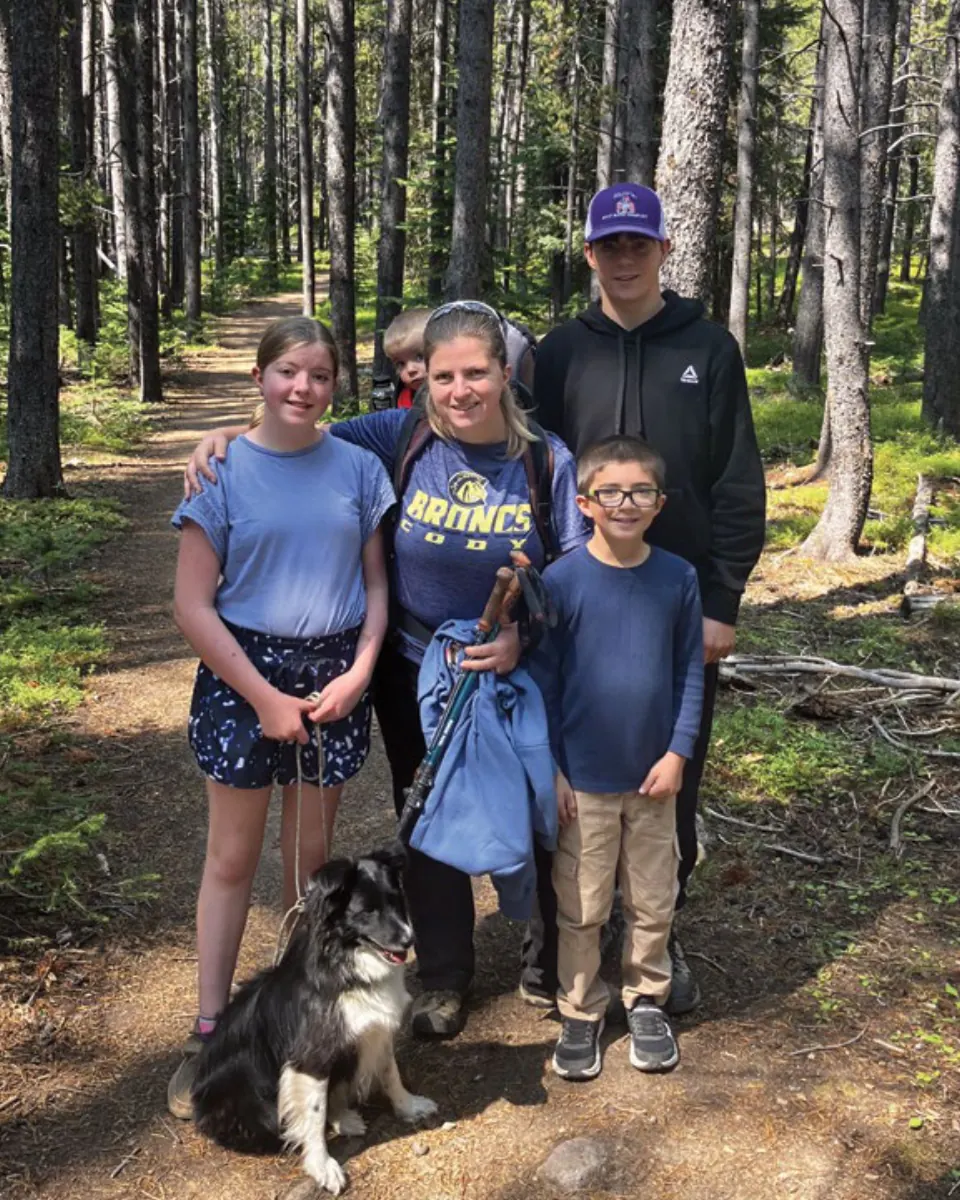
Chelsea Lyman grew up memorizing dog breeds from a book and dreaming of veterinary school. Decades later, on a homestead outside Powell, Wyoming, her days blur into a steady rhythm of motherhood and menagerie: two horses, four dogs, a flock of 4-H sheep, seven chickens, and two pigs, one of them named Lucky Daisy after she survived a dog attack and two days missing in a nearby alfalfa field. "I think that's just part of who I am," Chelsea says of her pull toward animals. She never became a vet. Instead, she built a life where the answer to what she really wanted was outside, waiting, the whole time.
The pull started early. As a girl, she played horses and dogs with her sisters and friends, showed in 4-H herself, and kept a dog breed book she'd memorized cover to cover by age nine. "When you're nine years old, you can memorize anything," she says. The plan, for a long time, was veterinary school. She earned her associate's degree in animal science and was headed down that path.
Then she started a family in her early twenties, and the plan changed. "I just pivoted," she says. "I had totally different priorities." She never went to vet school. But she never stopped needing animals in her life, and over the years since, she's found a quieter way to keep that piece of herself alive: through her kids, through 4-H, through a homestead that fills up a little more every year.
Chelsea and her husband both grew up near Powell and haven't strayed far from home. Their property holds an updated 1936 farmhouse shaded by cottonwood trees nearly as old as the house itself, a small barn and loafing shed for the animals, a yard, and a treehouse the previous owners built that her kids still climb into. Two horses. Four dogs. Seven chickens. A flock of ewes her thirteen-year-old daughter raises for 4-H, lambing them each winter and showing them at the county fair each summer. And, most recently, two pigs belonging to her nine-yearold son, Clark.
Ask Chelsea what a normal day looks like and the honest answer is that there isn't one. Mornings start around six, getting kids fed, dressed, and out the door. Somewhere in there she carves out a window to work, usually while her two-year-old is content enough to let her. By early afternoon, she's back to farm and family: driving kids to practices, managing whatever the animals need that day, keeping a household of six people running. "It's wonderful chaos," she says. "You just try to catch the most important balls in the air."
Everyone in the family has a role. Her daughter's sheep are hers to manage, from breeding to feeding to showing, and she's started earning her own money selling lambs at the 4-H sale each summer, half of it saved, some spent, some given away. Clark's pigs are his responsibility, and he has taken it seriously, researching what they should eat and writing his notes down in a notebook. The horses are shared between Chelsea and her daughter. The dogs rotate through whoever's turn it is. "Everybody has to pitch in," Chelsea says, and when one of them can't, whether they're sick, busy, or simply overwhelmed, someone else steps in without being asked.
That system was tested hardest the week Clark got his pig. It was his ninth birthday present, a piglet the family picked up on a Wednesday afternoon, the day before school started. They had never owned a pig before and didn't yet know how quickly one could dig its way out of an enclosure. Within an hour of getting her home, she was gone, chased off by a neighbor's dogs and badly hurt. The family searched until after dark, going door to door to warn neighbors, posting in local social media groups, checking for any sign of her. They found no blood trail, no piglet.
The search continued the next day. Chelsea's older daughter, who does online school and had more flexibility that afternoon, set out a cage with watermelon, a favorite of pigs, near where the piglet was last seen, and walked the fields and roadside looking for her. By evening, twenty-four hours in, the family had run out of ideas.
Then, on Friday, while Chelsea was in the middle of a work call, the doorbell rang.
Her neighbor was standing there, holding the piglet in his arms. She was alive.
"I couldn't believe it," Chelsea says. "I was just in shock." She grabbed the piglet, wounds and all, straight into her work clothes, and started treating her on instinct: cleaning what she could, texting anyone who might know a livestock vet, working out a penicillin dose from what they had on hand. Getting a vet out to see a pig, a cow, or a sheep in that part of Wyoming isn't easy. Demand outpaces the number of vets willing to make the trip, so most of the doctoring falls to whoever owns the animal.
That evening, the family discovered how bad the wounds
“Chelsea is the backbone of LedgerGurus. The business has quadrupled in size since she came into her role and she continues to manage all the parts and pieces part time in and around her kids. She produces the kind of financial details and insights we wish we were consistently creating for our clients. She has her head wrapped around every single piece of how our business works. Her wisdom and insights have been a guiding force for years now and she’s a key reason for our success.”
- Brittany Brown, Founder & CEO, LedgerGurus
actually were. The piglet had been out in the August heat for two days, and the injuries were infested with maggots. Chelsea and her family spent an hour and a half cleaning them out, then kept her inside the house, in a crate, for two more days to keep the flies off while the wounds healed. Eventually, with a vet's guidance on a second antibiotic and a proper wound wash, she started to recover.
Clark named her Daisy. The family started calling her Lucky Daisy.
"She is one lucky little piglet," Chelsea says. "I don't know that she would have come back from it if we hadn't found her when we did."
It is, Chelsea admits, just one version of what a day can look like in her house. Something is always happening. An animal gets hurt, a kid needs picking up, a meeting runs into a crisis nobody could have scheduled around. What she has learned, across four kids and a rotating cast of livestock, is not how to eliminate the chaos but how to move through it: prioritize, delegate, and trust that everyone, herself included, will show up for whatever needs them most that day.
She sees the same lesson taking root in her kids. Watching her daughter manage a small flock of sheep, or Clark research pig nutrition well enough to fill a notebook, Chelsea sees kids learning what it means to be responsible for something that depends on them, to show up even after a hard day, to feel the loss when they eventually sell an animal they raised. "There's tears shed at the end, usually," she says. "But then they start looking forward to the next project."
Chelsea never became the veterinarian she once pictured. What she built instead is harder to summarize and, by her own account, more her: a homestead full of animals her kids are learning to care for the way she once dreamed of caring for animals herself, a family that pitches in without being asked, and a version of the rural life she always wanted, even if it took a decade and a very lucky piglet to prove it was still hers all along.
"I really do it for them," she says, "but I really started because living the rural lifestyle was part of who I am."
Text adapted from the print edition of Élevé.
 This Is Exactly Where We’re Meant to Be
 From Banana Hats to Flight Lines
 I Do Belong Here