Élevé · Issue 3 · Coming Back
A Creative Life, Waiting Its Turn
In the middle of loss, homeschooling, and uncertainty, Jennifer Feinson picked up a paintbrush. What followed wasn’t just a way to pass the time, but the beginning of a
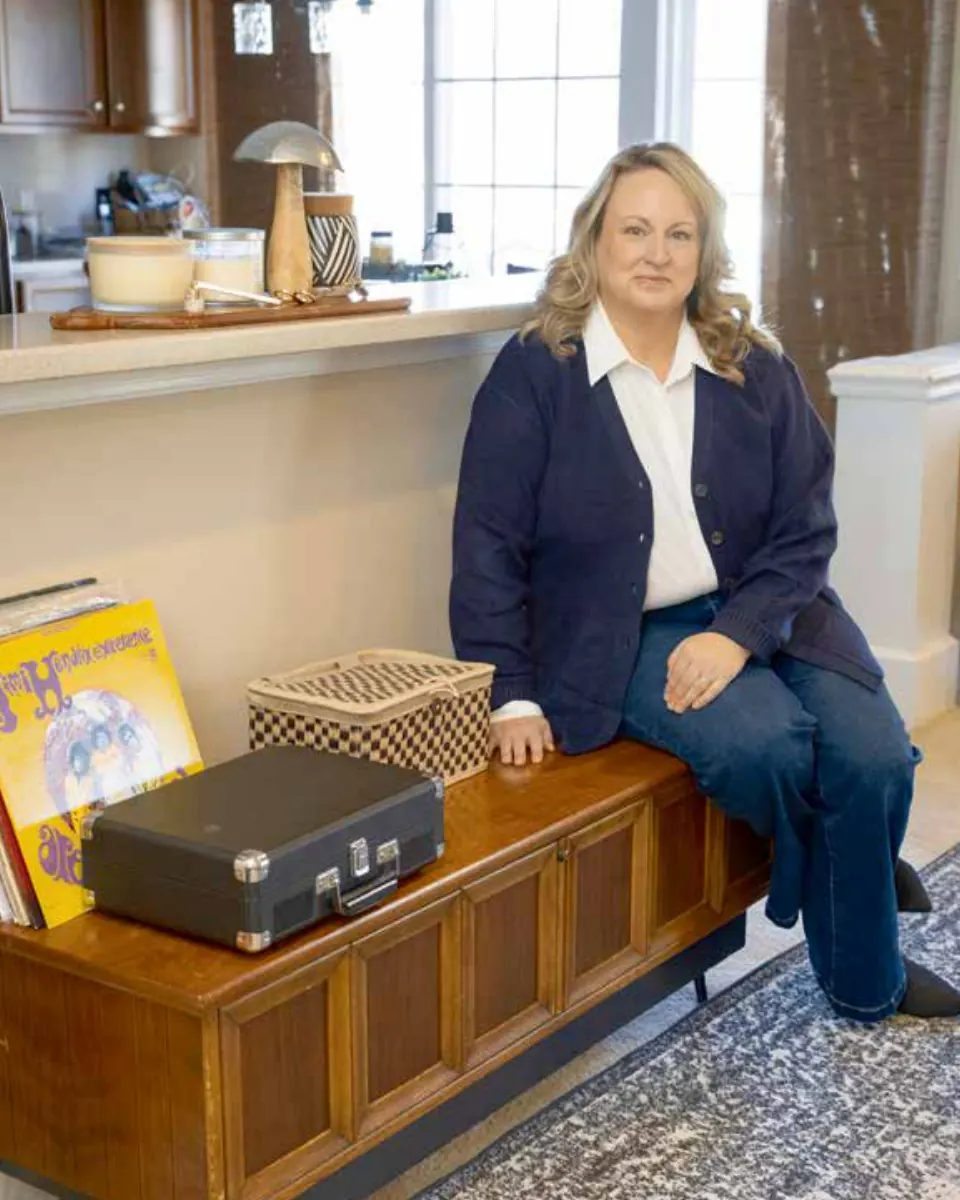
It started during COVID,” Jennifer says, tracing her dream back to a time that was already filled with loss, uncertainty, and two kindergartners at home. Her father had passed away just months before, and suddenly, life had slowed in a way she hadn’t chosen. Down in the basement, where a bouncy house helped her boys burn off energy, Jennifer noticed furniture she had been meaning to work on for years. “Why don’t I just start one of these projects?” she remembers thinking. She didn’t have formal training, just YouTube videos and a willingness to try. What began as something to keep her mind active soon became something she genuinely loved, and eventually, a dream of opening a studio where she could create freely.
For more than 30 years, Jennifer built her career in accounting and finance, a path defined by structure, precision, and steady progression. Creativity wasn’t absent from her life, but it lived more on the edges, something she appreciated rather than something she actively pursued. It wasn’t until everything slowed that she had the space to notice what had been quietly waiting.
At the time, her twin boys were just beginning school, navigating their first year from home. Like so many families, their days were a mix of screens, schedules, and restless energy. To help them move, to give them a break from sitting still, Jennifer set up a bouncy house in the basement. It became a place for them to burn energy, but also, unexpectedly, a place where something else began.
“I was down there with them while they were going crazy,” she says. “And I just kind of noticed these pieces of furniture I had that I kept meaning to do something with.”
They had been there for a while, solid wood pieces that she knew had value, even if they didn’t quite fit her home as they were. Like many things in a busy life, they had been waiting for the right moment, or at least a moment with enough time attached to it.
This time, she decided to start. At first, it was simple. She began experimenting with paint, learning how to stain, figuring out what worked and what didn’t. There was no formal training, no structured plan. “I would honestly go on YouTube,” she says. “There’s a community that does this kind of restoration work.” From there, she learned by watching, by trying, by making mistakes and adjusting.
It was, in every sense, a process of learning by doing.
What surprised her most wasn’t just that she could figure it out, but how much she enjoyed it. The work required patience, attention, and a willingness to sit with something long enough to understand what it needed. Each piece brought its own decisions.
Sometimes, she would look at something and feel it didn’t need to be changed much at all. “It’s really beautiful the way it is,” she says. In those cases, her goal was to bring it back, to clean it, restain it, give it shine again, and restore it to what it might have looked like when it was first purchased.
Other times, the piece invited something different. A shift. A new identity. Maybe a darker base, a lighter top, something that felt more modern, more aligned with how people live now.
“Each piece is different,” she says. “You can kind of see the potential in it.”
That idea, potential, is what keeps drawing her back. Not just in the work itself, but in the stories behind the pieces.
One of the moments that stayed with her most came when she picked up a cedar chest from an elderly woman who was moving into assisted living. The piece had been listed to give away, but when Jennifer arrived, the experience felt different than the others.
“She told me it was her wedding chest,” Jennifer says. “She told me the whole story.”
The chest had been part of her life for decades, something that had lived in her home through different chapters. Jennifer took it with the intention of restoring it, but also with a sense of responsibility to honor what it had been.
“I told her, I promise I’m doing something with this.”
Today, that piece lives in Jennifer’s home, transformed into a side table with new legs, but still carrying the story it came with. “It had been in somebody’s home for 50 years,” she says. “That was kind of an interesting dynamic.”
It’s not just about furniture. It’s about continuity. About taking something that might otherwise be discarded and giving it a new place to belong.
Right now, all of this happens in a small, makeshift studio in the corner of her basement. It works, but it comes with limitations. Furniture is not small. It requires space to move, to sand, to stain, to let things sit and dry.
“When it comes to furniture, it’s all about having the space,” she says.
When she talks about her dream, that’s where it starts. Space. Not just more of it, but the right kind of it. A studio that allows for both the work and what comes after.
She imagines it as two parts. A workshop where she can do the hands-on work, sanding, staining, building, and a showroom where the finished pieces can live. A place where people can walk in, see what she’s created, and maybe even bring in pieces of their own to be transformed.
“If somebody wants to bring a piece that they want redone, they would have a place to come,” she says.
It’s a vision that extends beyond just making things for herself. Because as much as she enjoys the process, she also knows there’s a limit to how many pieces she can keep.
“There’s more pieces I’d be interested in doing than I’m able to keep,” she says. “It’s about the creation part and then the finished product. And then give it to somebody who will use it and enjoy it.”
That idea, of creating something and then letting it go, is part of what makes the work feel meaningful. It’s not about accumulation. It’s about transformation.
Right now, time is the biggest constraint.
Between her career and her family, there aren’t long stretches available to spend in the basement working on projects. Her boys are older now, active, and her days are full in a different way than they were during COVID.
“I’ve slowed down because I’m busier,” she says.
But the dream hasn’t gone anywhere. If anything, it has become more defined.
“I think that’s why this is a dream,” she says. “At that point in my life where I have that time to dedicate to something, I really think I want to do something creative.”
She doesn’t attach it to a specific timeline. It’s less about when and more about readiness. A next chapter, whenever that arrives, where there is space not just physically, but mentally, to build something different.
“When I’m ready to move into that next chapter,” she says. “Even if I’m not working as much, and there’s more time.”
There’s also something else woven into that vision, something she hopes her sons might take with them.
One of them, she notes, naturally gravitates toward the arts. Toward creativity in a way she didn’t pursue in her own career. Watching that has shifted how she thinks about what’s possible.
“I think if you want to be creative, you can create a business out of it,” she says. “It can be a career.”
It’s a quiet but important belief. That creativity doesn’t have to sit on the sidelines. That it can be something you build a life around, not instead of stability, but alongside it.
For Jennifer, that realization came later. But it feels no less real.
The studio isn’t built yet. The time hasn’t fully opened up. But the work has already begun, in small, steady ways, in a basement corner, in pieces that move from forgotten to finished, from past to present.
And when that next chapter comes, she won’t be starting from scratch.
She’ll be continuing something she’s already started.
Text adapted from the print edition of Élevé.
 What Happens When the Dream Isn’t Enough
 What If Your Biggest Dream Was the Impact You Leave Behind?
 More Than a Stamp: The Tradition That Keeps Them Coming Back