Élevé · Issue 4 · Quietly Extraordinary
We All Contain Multitudes
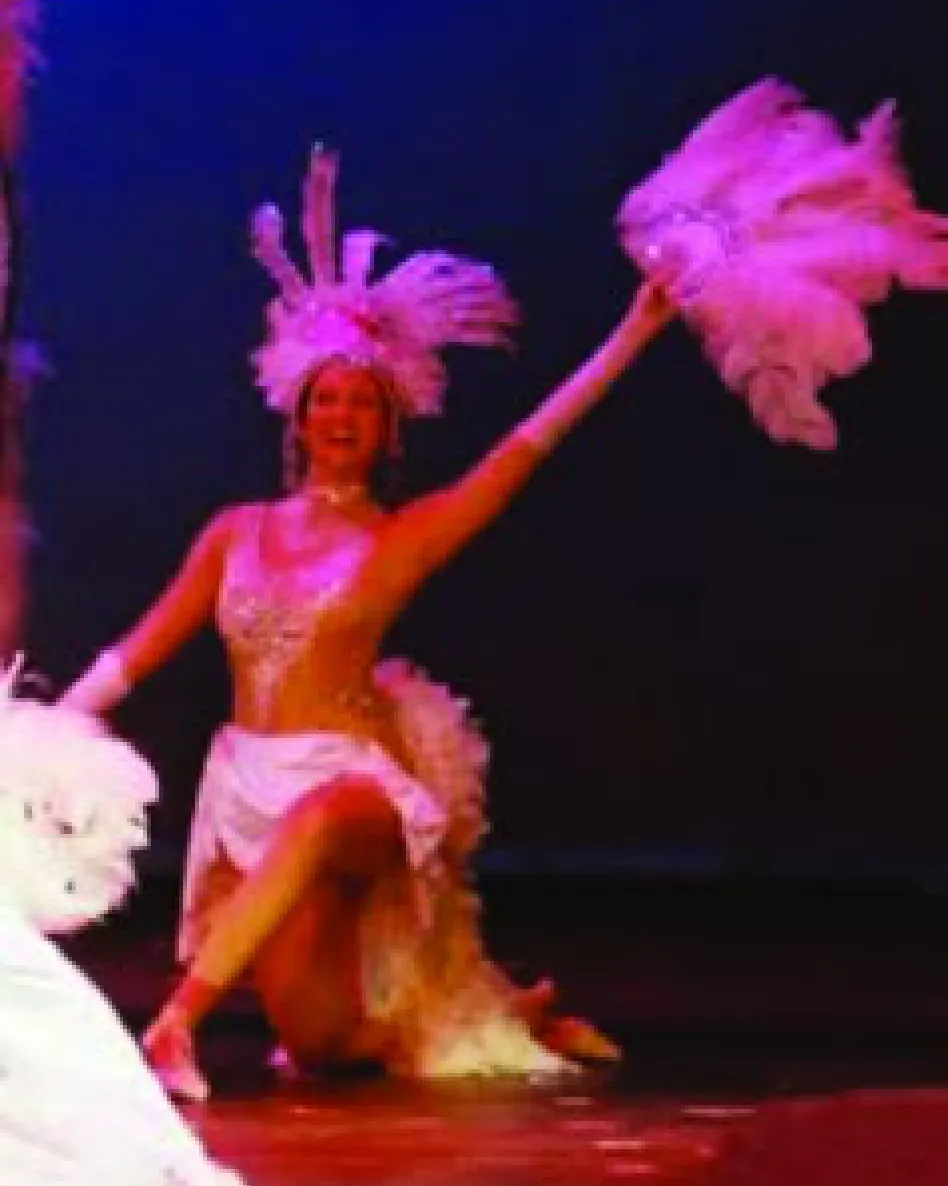
At sixteen, Mary Elizabeth Warren stood on the field at Super Bowl XXXIV in Atlanta, dancing Proud Mary behind Tina Turner while a stadium roared. She calls it electric, a word she keeps returning to, decades later, from the far side of a career in accounting. Most people who know Mary Elizabeth now know only one of her: the numbers person who can lock in on a spreadsheet for twelve hours. Few know the girl who leapt across a dance studio at three because it “felt correct in my body,” or the young woman who turned down Disney and national tours to build a life that would stay in one place. She contains, as she puts it, multitudes, and considers that her greatest asset.
That word, multitudes, is the one she reaches for when you ask what it is like to be all of these people at once. The performer. The stay-at-home mom she was for seven years. The accountant she is now. Different groups of people know her as different things, and for a long time those worlds sat apart from one another.
She has stopped experiencing that as a contradiction.
“Everyone contains multitudes,” she says. “Nobody is so two dimensional. It feels correct to be a whole, three dimensional person with all of these life experiences that make life richer.”
The stage came first, and it came early. She was three years old, sitting in a circle in a dance class, when she got up and leapt across the floor. She still remembers the pleasure of it.
“It felt correct in my body,” she says. “It was never not a good time. It always felt right.”
She danced competitively as a child, then began booking professional work through her middle and high school years. Atlanta, mostly, and later two separate chapters in Virginia.
The Super Bowl gig was the one that told her, even at sixteen, that she had wandered into something big. She was one of hundreds of dancers, “me and four hundred of my closest friends,” she jokes, but she knew what it meant to share a field with Tina Turner. Performing in a stadium was nothing like performing on a stage, even a large one. It satisfied something specific in her, a competitive streak and a certain brand of
So she went. Fine arts majors, she argues, do not get enough credit for how much they carry. Up at eight in the morning, four days a week, in pink tights for an hour and a half of ballet, then coursework, then rehearsals at night. The rigor was relentless. But the thing those years in Gainesville gave her that she still leans on hardest was permission to take up space. Being an employable performer, she says, demands that you command a room without apology, in the full confidence that you deserve to. For a teenager coming of age when the media was particularly cruel and misogynistic, that was no small thing to learn.
Mary Elizabeth Warren
By her senior year she was landing featured roles, and with them came pressure, visibility, expectation. She auditioned over a Christmas perfectionism she has since recognized in high performers of every kind. Getting the gig was rewarding on its own. Getting to perform it was the icing on the cake.
College was the logical next step, though logical is a generous word for a choice between theater and dance when you also love to sing. She and her family had poured years and resources into developing her as a performer. It was either major in it or turn professional straightaway, and she was not quite ready to leave the nest. break, booked the job, and left school a month early to take it, straddling the academic world and the professional one before either had fully released her. This was 2006, long before remote classes made that kind of thing ordinary.
Then the offers kept coming, and the deciding began. Or rather, the not-deciding.
A cruise line. A national tour. Disney, which wanted her as a villain, though she had wanted to be a princess and was too tall at five foot nine. Each call posed the same question. Was she willing to uproot her life, move for six or nine months, and land back at square one when the contract ended? The answer kept coming back no.
“I decided by not deciding,” she says. By about twenty-five, the offers had stopped, and she had let the door close.
Ask what leaving cost her and she does not hesitate. It was the electricity. The euphoria of eight shows a week, the thrill of an ensemble, the power of watching an audience receive what you are giving them. Collective effervescence.
“The kinds of shows I was primed for were light and fluffy entertainment. Nothing that was changing peoples’ lives, but so fun! For me, there’s so much more to life than that, than applause and spotlights,” she says, and yet she misses it.
What she got in exchange was harder to see but, she insists, invaluable. Stability, and proof that she had worth beyond the things about her that were marketable, her dance skills, her singing, the way she looked at the time. Building a self that could stand on its own two feet, that could speak without a script and be herself in a way that was not performative, gave her a depth she was not sure the stage alone would have.
The years that followed humbled her further. She taught dance, married the man she had been dating through the in-between, had a daughter a year later, and stayed home for seven years. She had thought she understood work. She learned that caring for a small person, like caring for an elderly one, is labor, and badly underappreciated labor at that. The aloneness built a mental toughness she had not needed onstage.
“It’s a job. It’s a job,” she says, of caretaking. What she carried through all of it was a conviction about why any of it mattered. Being allowed to pursue artistic passions as a child, she believes, is the reason her brain is her asset. Theater is storytelling, and storytelling builds empathy. Dance does something quieter, and something she suspected for years was real. She recently found the study that confirmed it, work published on dance and neuroplasticity.
“That’s it, like bingo,” she says. She had always sensed there was something particular about dancers and the way they move through the world. Now she has the word for it. Dance trains the brain to adapt, to learn through experience, to stay flexible under pressure. And in the current climate, she considers the ability to absorb new information, assess it critically, and change your mind when a better idea comes along to be about the most valuable skill there is. In a moment when the cultural advice runs toward skip college and learn to code, she is making a different case entirely. An artistic upbringing, she says, builds an understanding of how much work a finished product takes. It builds critical thinkers. Team players.
She is watching that conviction play out one row back now. Her fourteen-year-old daughter is a competitive dancer, sometimes on the very same competition circuits Mary Elizabeth once traveled. Being on this side of it is wild, she says, and full of pride, because she knows exactly what went into every routine.
What moves her most is watching her daughter take up space the same way she once learned to, unapologetically, sharing her art in front of a room full of strangers without hesitation. That tenacity, that willingness to be emotionally open in public, is exactly what she thinks arts education gives kids, and adults, that a classroom or a professional certification cannot.
“When we give kids room to feel things out loud, we’re raising adults with more empathy,” she says. A small way, she calls it, to make the world a little kinder.
She has the long view her daughter cannot have yet. She remembers when a plastic trophy felt like life or death. Now she can help her daughter zoom out, name the real value, and find it in the journey rather than the prize.
And every so often, the years collapse entirely. There is a moment in the dressing room, a convention-center ballroom full of hundreds of girls with their little suitcases of costumes on hangers, each one carving out three feet of space to run her routine, staring at the wall, locked in. Mary Elizabeth watches her daughter do it.
“That is like looking in a mirror thirty years ago,” she says.
The throughline she wants a reader to see is not any single one of her lives. It is the fact that they add up, and that the adding up is the point. She offers herself as evidence. If you had told twenty-year-old Mary Elizabeth she would one day be chief operating officer of an accounting firm and partner in a tax firm, she could not have fathomed it. And yet, here she is.
A neuroplastic brain, she says, can take you anywhere. Her advice, delivered with a performer’s timing: hire artists.
“We all contain multitudes,” she says, “and that is our greatest asset.”
“Mary Elizabeth protects our company fiercely. She cares deeply about the quality of our work, the impact we have on our clients, and the reputation we’ve worked so hard to build. Every decision she makes considers what is best for the company and, even more importantly, what is best for our team. She leads without ego, never asking, “What’s in this for me?” but instead, “What’s best for all of us?” That kind of ownership, loyalty, and selfless leadership says more about who she is than any job title ever could.” - Diana Gleason, Founder + CEO, DG Accounting
Her age performing at Super Bowl XXXIV, behind Tina Turner
The height that got her cast as a Disney villain, not a princess
WHAT YOU’D NEVER GUESS Before the spreadsheets,
there was a stage. The other math of Mary Elizabeth Warren.
The age she started dancing, leaping across the studio floor
Shows a week at her performing peak
Years she spent home, raising a baby
Years between her dressing room and her daughter’s
“We all contain multitudes.”
Text adapted from the print edition of Élevé.
 “Maybe This One Is for Me”
 Why Not Us
 How One Diagnosis Rewrote Her Whole Story