Élevé · Issue 2 · Rooted in Resilience
Life, Loss, and the Leap Forward
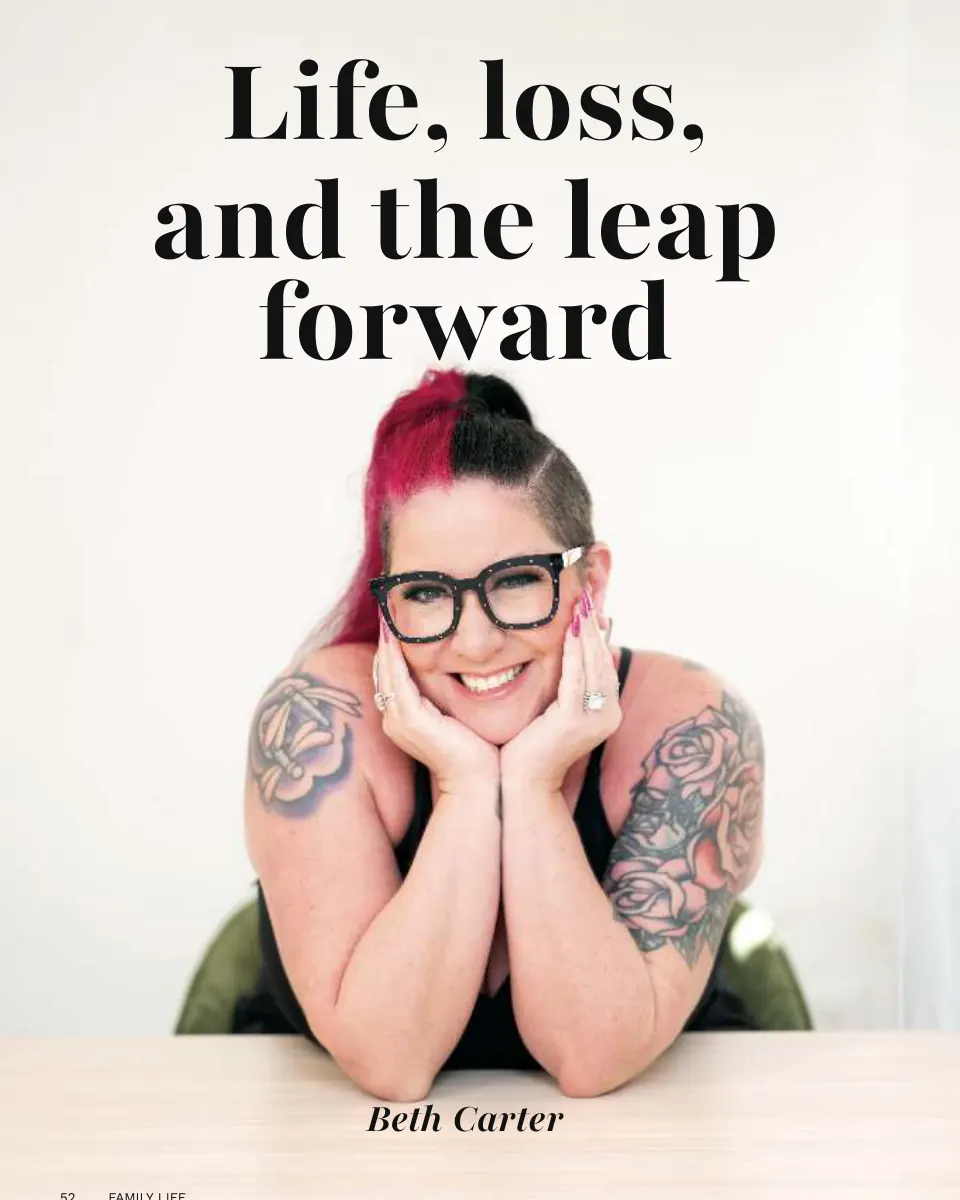
When Beth Carter speaks about her mother, there’s a stillness in her voice that carries both ache and gratitude. The loss came too soon. Her mom was only in her early sixties, diagnosed at stage four with little time to prepare. Beth remembers sitting by her side in hospice, watching the decline, holding her hand, and realizing in real time that life would never again be the same. “It was more about when she was in hospice that I had that life-is-short aha moment,” Beth recalls. The stillness of those days, the dimmed light of hospital corridors, the soft rhythm of machines, became a mirror she could not look away from. And in that mirror, a question she hadn’t let herself ask, “Why am I subjecting myself to a life that doesn’t feel like mine?”
The moment everything shifted
At the time, Beth was still employed at a company where her absence sparked frustration. “That was really hurtful to me because I knew how much energy and time and love that I put into that company. And so to feel like they couldn’t give me grace for the end of my mom’s life was… really hurtful.” The mismatch between her devotion and their lack of compassion became impossible to ignore. She had been loyal, tireless, deeply invested. Yet as she watched her mother’s time slipping away, the contrast sharpened: she was giving herself to a system that would never give back. “I remember thinking: this isn’t right. I don’t know what else is out there, but this can’t be it.” leaving without a map Beth had no blueprint for entrepreneurship. “I didn’t know anything about entrepreneurship at that point. I didn’t have friends who had gone out on their own. I had no idea,” she admits. What she did have were a couple of side clients and a vision of freedom. “I thought, if I get more than just a couple clients, I can be an outsourced bookkeeper. Awesome. I can pick my own schedule. I can not be working to the bone. And I can take time when I need it.” She smiles at the memory now—so naïve, so bold. Entrepreneurship, of course, turned out to be far more complicated. But that naïve clarity was a lifeline: there had to be a different way to live and work.
What she didn’t say
Beth never told her mom she was leaving her job. “I didn’t want her leaving this world worried about me and my daughter and would we make it? Even though in reality, looking back, she would have known I’d make it work.” It is one of her few regrets, that her mom never got to see what came next. The business. The seven-figure success. The life built on the ashes of grief. “I cannot even imagine if she could see what I have built now. God, I would give anything for her to see that.” And yet, Beth can hear her voice still. “She would be excited,” Beth says softly. “But at the same time, not surprised.”
A mother’s echo
Her mom had always been her loudest champion. “She was absolutely my biggest cheerleader. She saw that rebellion in me from day one and encouraged it so hard. She wanted me to be me,” Beth remembers. Her mom had been a rebel as a young woman, then somehow slipped into the opposite, conforming, sacrificing. It was why she fought so hard for Beth to hold onto her spark. “She wanted me to play to my own beat, even while she wished for me to have stability. She wanted me to have the life she didn’t.” That encouragement is stitched into Beth’s DNA. Every bold move she’s made, every leap she’s taken, carries her mom’s fingerprints.
Building differently
From those painful hospital days grew a radical clarity about the kind of workplace Beth wanted to create. “If you are sick, literally do not even think about calling me and doing the fake cough thing. Just put it in our calendar. If you need to go take a nap in the middle of the day, do it. I don’t need to know,” she insists. She remembers her own corporate years vividly: the panic of calling in sick, the guilt of doctor’s appointments for her daughter with special needs, the shame of being human in a system that expected perfection. “I built the company that I myself would have wanted to work for. Life is short and your family comes first. If you need to take your child to a doctor’s appointment, you shouldn’t have a job that makes that not okay.” Employees sometimes struggle to believe her at first. “I’ll hire new employees in their fifties who are clearly adults, and they’ll over-explain. ‘I have to go to the pharmacy right now because…’ And I’m like, okay. You don’t need to explain. Just go.” The freedom shocks them. And that’s exactly the point.
Life outside the office
Her philosophy doesn’t end at work. With her husband, “the love of my life unicorn”, Beth balances responsibility with indulgence. They talk about investments, savings, retirement. And then they talk about joy. “Should we be putting that money into retirement? Probably. But if we wait until our retirement egg is full, who knows how long that will take? Why are we not going to enjoy it right now?” So they play blackjack. They dream of an indoor pool, a game room, a library. “It’s not necessary. But it’s what we want.” The balance is everything: responsible, but never waiting too long to live.
Grief, fully felt
Beth does not romanticize her grief. “It was the most painful thing I’ve ever experienced.” She lost not only her mom but, around the same time, another best friend to cystic fibrosis. Loss after loss, stacked too young. One of the most impactful things, she says, was taking time off to grieve. “If I was still working for somebody else, I would not have been able to do that.” She let herself feel it fully, not stuff it down. Because grief ignored only festers. And in the quiet of those days, she learned to look for the silver lining. “It feels awful to say that there’s a silver lining. But there’s such a huge difference between being able to look back and see it and happiness that something happened. I am thankful that I have that ability now.”
What life is short really means
The mantra that began in hospice has become the spine of her life. It shows up in how she leads her team. In how she spends her weekends. In how she parents her daughter, Brooke. “It’s taught me to look for the silver lining in bad situations,” Beth explains. A client firing you, a key employee quitting, now she sees it differently. Maybe that client wasn’t aligned. Maybe that employee was holding the team back. “There’s always something forward waiting to come out of it.” And in her personal life, “life is short” means not waiting for retirement to book the trip, buy the thing, or build the pool. It means saying yes now, because tomorrow is never guaranteed.
The echo that remains
Beth sometimes imagines the conversation she would have with her mom now. The woman who cheered her rebellion, who believed in her before she believed in herself. “She would just say, well of course you built a seven-figure business. Of course you’re successful. Of course you kept taking care of Brooke. She would be excited… but not surprised.” And so Beth keeps building. Keeps leading. Keeps living. Carrying forward the echo of her mother’s voice, the urgency of loss, and the fierce insistence that life is short, too short to wait, too short to settle, too short not to live.
Text adapted from the print edition of Élevé.
 The Art of Becoming
 The Weight of Belonging
 The River Knows the Way