Élevé · Issue 2 · Rooted in Resilience
Through a Mother’s Eyes
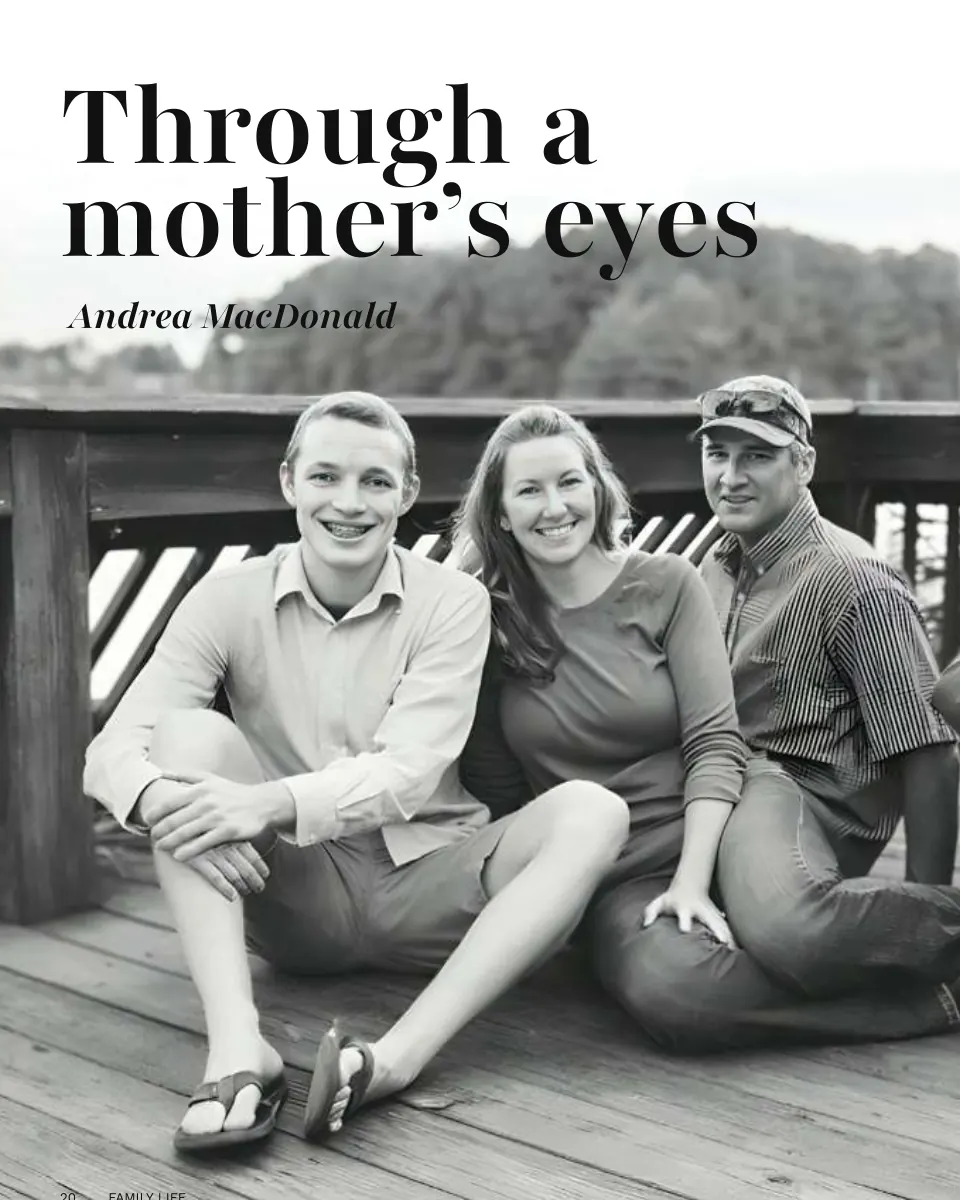
There is a peculiar vertigo that arrives when your children develop what Andrea MacDonald calls their “man voices.” One morning you are reminding them to pick up wet towels; the next, they’re wearing wedding bands, signing mortgage papers, and speaking to you about interest rates. Andrea is in the season of life when your kids are, as she put it, “grown grown.” Both sons married this year. One of them, Eric, who now works beside her, troubleshooting client issues and asking the kind of questions that leap two steps ahead. The other, fiercely independent, just bought a house.
The better life we imagine for them
Andrea grew up squarely middle class, the kind of home where there was enough, until, suddenly, there wasn’t. Her parents, loving and human, were not good with money. It’s almost comical, she says, that she became an accountant; for years, she struggled with the very patterns she now helps clients untangle. “I just wanted a different starting line for my kids,” she tells me. “No debt spiral, no waiting on a tax refund to breathe.” She also wanted time, time they wouldn’t feel obliged to rush. “I was married at nineteen, a mom at twenty, then again at twenty-one,” she says. “Babies having babies.” She doesn’t romanticize the grit required. Nor does she regret it. But she hoped her sons might build a foundation first. They did. Jobs, marriages, a house, “in the proper order,” she laughs, half-teasing herself.
The years you miss, and the ones you make
Andrea didn’t start college until after both boys were born. She worked full-time, then sprinted to campus for night classes (there were no online options), returning home long after bedtime. She shared custody after separating from their father when the boys were six and five, and then work asked for more: four straight months out of town during the Deepwater Horizon oil spill. “From the other side, I can see the gaps,” she admits. “Entire chunks I didn’t get to witness.” Mothers tend to keep track of the almosts, the missed field days, the phone calls returned too late. Andrea has raised sons willing to tell her they don’t remember it that way. They remember swim meets and cross-country races; the drive-through dinners; the stubborn, bright thread of presence in whatever minutes she could wring from the day. They remember a mother advancing, visibly, toward a life that would carry them, too.
The day the mother becomes a woman again
Ask any woman who has loved, married young, and then unstitched the life she knew: there is a second coming-ofage. Andrea’s arrived at twenty-seven, when she and her first husband, “good parents, wrong marriage,” untangled with unusual grace. They agreed on week-on/week-off custody while the temperature was still low. And then came the shock of the quiet: the first Tuesdays she didn’t cook for anyone; the first Thursdays when nobody needed a ride. “I cried an entire week at a time,” she says. “I couldn’t eat. Then, slowly, I remembered I existed.” There were harder recalibrations. Health issues in her late twenties led to a hysterectomy. She had already decided not to have more children, “I couldn’t imagine a child at home fulltime while my boys were there only half the time”, but the permanence of a choice removed, she says, “landed like a stone.”
Work as a love language
Her first job was at twelve, a paper route, and she’s worked ever since. Even now, with sons who can afford to say no, she is most proud that they don’t. “Work ethic. And being good humans,” she says, listing the two values she drilled with a steady, midwestern cadence. The delight is that the lesson stuck. They are generous without being performative;
On advice she gives
curious without being cynical. When Eric joined her firm in 2020, he took the worst seat in the house, the front desk, then started asking questions two and three moves ahead of what anyone had taught him. She watched his mind catch fire. “Someone,” she jokes, “raised this guy right.”
Married at nineteen, mother at twenty, people had opinions… but she barely heard the noise. “I was too young and cocky to care,” she says, not unkindly. Perhaps that was a grace. She made choices; she lived them; she learned. If she could give other women one piece of advice, it would be this: “Don’t overthink it. Kids are really resilient. You’re going to mess up sometimes, just treat them well, do your best, and know they’ll remember that more than the bad nights. The hard stuff passes, and before you know it, they’re grown and out there living their own lives.”
The women they chose (and what that tells us)
There is an invisible barometer in a mother’s heart, and it calibrates on the people our children love. Both sons married special education teachers they’ve known since high school; all four swam on the same teams years ago. The families are already close. The four of them gather for dinners on random weeknights, no occasion required. In a world where so many people feel disconnected, that kind of closeness feels rare and special. Andrea beams at the symmetry, then grins at the chaos she’s hoping for next. “I have so much mom energy,” she says. “I’m ready to funnel it straight into grandma energy.”
What remains
Across the conference table, her son unravels a client’s knot that once would have cost her a weekend. He listens first, then triangulates quickly, an instinct she recognizes as her own. The younger one carries a different kind of brilliance, a stubborn competence that fixes problems before anyone has time to applaud. And then there’s the state swim meet, the walkout song “Let It Go,” of all things, that brought the house to its feet because a teenage boy chose delight over cool.
Text adapted from the print edition of Élevé.
 The Decade She Stayed Silent
 You Can Go There, but You Can’t Stay There
 In the Company of Horses